


TL;DR. A blockchain development company designs, builds, and ships on-chain systems: smart contracts, dApps, RWA tokenization platforms, DeFi protocols, and the integrations that connect them. Choosing the right one in May 2026 means matching three variables: chain fit (do they ship on your target L2, or on permissioned networks like Canton if your build is institutional?), domain depth (RWA tokenization, ERC-3643, DAML for institutional settlement), and engagement model.
Portfolio size and Clutch star counts are table stakes. The real question is whether a vendor's shipped projects resemble your build. Aegas has been building on-chain systems since 2017, has delivered 100+ projects, and holds a 4.9/5 rating from 14 verified Clutch reviews. The sections below cover the decision logic most of the SERP skips.
What does a blockchain development company actually do in 2026?
The short answer: it builds on-chain systems from protocol design through production deployment. The longer answer matters because the term gets used to describe at least five distinct service profiles that serve different buyers.
Protocol and smart contract development is the core. This means writing, testing, and deploying contract logic in Solidity, Rust, Move, Vyper, or DAML, depending on the target chain. A firm doing this well can show you named engineers, a public test suite, a deployment address, and a post-launch incident record. See Aegas smart contract development services for what this looks like scoped end-to-end.
dApp frontend and integration connects contract logic to users. This layer involves indexers, subgraphs, wallet connection libraries (Wagmi, RainbowKit), and backend services that translate on-chain state to product UX.
RWA tokenization infrastructure is where demand has grown most sharply in 2026. On-chain real-world assets (tokenized Treasuries, private credit, real estate) reached $31 billion in TVL by April 2026, up from $7.8 billion at the start of 2025. Building this correctly requires ERC-3643 implementation for regulated security tokens, identity-linked permissioning via ONCHAINID, and, for EU-adjacent issuers, early coordination with the project's own compliance counsel so token classification and disclosure questions are settled before contract design begins.
Auditing and security review is a separate service that verifies what has already been built. A blockchain development company and a smart contract auditor are not the same vendor category. Aegas, for example, ships code and coordinates third-party audits with firms like Hacken; we do not self-audit our own contracts. You may need both vendor types on a single project, and the conflict of interest in having your builder self-audit should inform your procurement approach. See our note on coordinating smart contract audits for how this typically gets scoped.
Advisory and consulting covers chain selection, token economics design, governance modeling, and regulatory mapping before any code is written. Buyers who haven't made these decisions tend to lose two to four weeks of build time renegotiating mid-engagement, which a paid scoping engagement usually prevents.
The 2026 demand picture is concentrated in two vectors: RWA tokenization (driven by institutional capital and the ERC-3643 ecosystem) and EU-adjacent issuance operating under the July 1, 2026 MiCA full-application deadline. Any firm not visibly building in these areas today is operating with a 2023-era service map.
What changed in 2026 – and why it matters when choosing a vendor
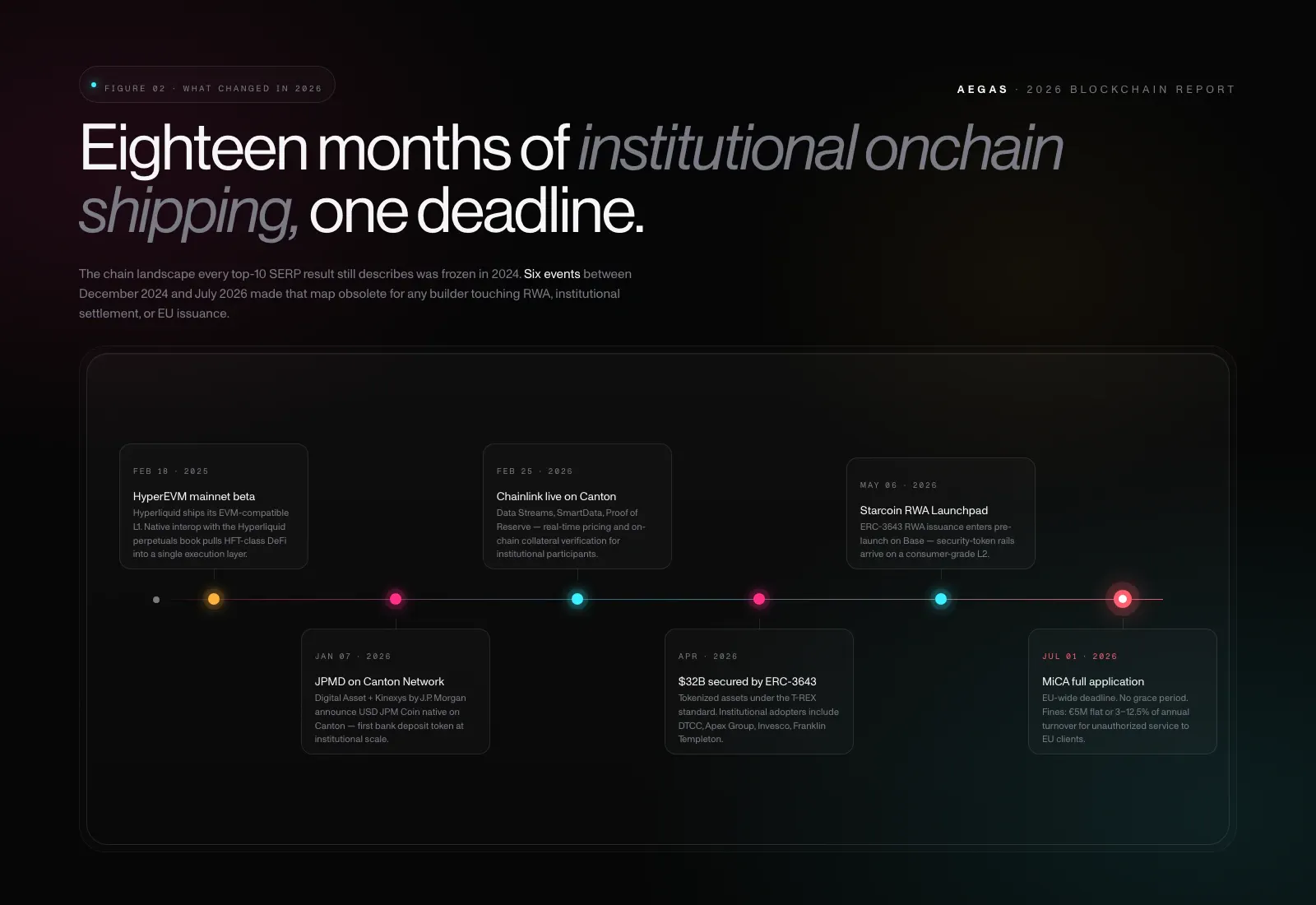
Every top-10 SERP result for "blockchain development company" anchors to a 2024 or earlier chain and regulatory landscape. None of them name Canton Network, Sonic, ERC-3643, or MiCA with current dates. That gap matters directly if your build touches any of these four areas.
Canton Network and DAML
Canton Network now processes approximately $350 billion in daily U.S. Treasury repo transactions and spans 600+ institutions with $6 trillion in tokenized real-world assets. On January 7, 2026, Digital Asset and Kinexys by J.P. Morgan announced their intention to issue USD JPM Coin (JPMD) natively on Canton – the first bank-issued deposit token targeting institutional-grade privacy-preserving settlement. On February 25, 2026, Chainlink Data Streams, SmartData, and Proof of Reserve went live on Canton; institutional participants now have real-time pricing and on-chain collateral verification.
Canton runs on DAML (Digital Asset Modeling Language), a purpose-built contract language for permissioned distributed ledgers. DAML's design prevents mempool front-running, provides privacy-preserving workflow composability, and supports cross-ledger interoperability without requiring a public mempool. For institutional buyers building settlement infrastructure, repo tokenization, or regulated asset custody, DAML on Canton is not an exotic option – it is where JPMorgan and Goldman Sachs are building. A development firm that doesn't list DAML as a stack competency is not equipped for this work.
High-throughput EVM L2s and L1s
Throughput pressure on Ethereum L1 has pushed most live DeFi build activity onto L2s and high-TPS EVM L1s. Base remains the default for consumer dApps with Coinbase-adjacent distribution. Sonic, an EVM-compatible L1 that went mainnet on December 18, 2024, advertises 10,000 TPS and sub-second finality and includes a Fee Monetization model that returns a share of transaction fees to developers. Neither is the "right" default chain for every build; the right answer depends on whether your throughput, MEV, and liquidity requirements actually justify moving off the more battle-tested L2s. A vendor that pushes one chain regardless of fit is solving for their own familiarity, not yours. Chain lifecycle is also a real concern: ecosystems that looked promising in 2024 have since wound down, so chain selection in 2026 should weigh ecosystem health alongside raw throughput.
ERC-3643
ERC-3643 (the T-REX Protocol) is the operative standard for regulated security token issuance. As of April 2026, over $32 billion in tokenized assets are secured by this standard, with institutional adopters including DTCC, Apex Group, Invesco, and Franklin Templeton. On May 6, 2026, the Starcoin ecosystem's RWA Launchpad using ERC-3643 entered pre-launch on Base. The standard's ONCHAINID identity layer enforces permissioned access at the contract level, which is what makes ERC-3643 a viable alternative to raw ERC-20 for any asset that requires investor identity verification.
Any vendor pitching RWA tokenization services in 2026 without visible ERC-3643 implementation experience is working from an incomplete toolkit. See our asset tokenization overview for how these standards connect to real-world deployment. Aegas builds ERC-3643-compliant tokenization infrastructure through our RWA blockchain development service.
MiCA
The Markets in Crypto-Assets Regulation reaches full EU-wide application on July 1, 2026, with no further grace period. After that date, any entity providing crypto-asset services to EU clients without a MiCA authorization is in breach of EU law. Fines start at €5 million flat or range from 3% to 12.5% of annual turnover depending on the violation type. An estimated 35% of blockchain startups project their annual MiCA compliance costs will exceed $500,000.
For buyers building any EU-adjacent product, token issuances, DeFi platforms, digital asset custody, MiCA is not a post-launch legal checkbox. Token classification (e-money token, asset-referenced token, or utility token), whitepaper disclosure requirements, and reserve asset rules sit downstream of legal counsel, not the development vendor. What a competent development partner brings to this conversation is a stack and architecture that can accommodate whatever classification your counsel lands on, instead of locking you into an ERC-20 implementation that has to be refactored once the legal opinion arrives. Treat MiCA decisions as your legal team's call; treat MiCA-compatible architecture as your build team's job.
How do I choose the right blockchain development company?
Most answers to this question on the web are self-promotional lists. The firms that rank highly write their own evaluation criteria. This section inverts that: here are five tests a buyer can run on any development firm before signing a contract.
Test 1: Do they actually ship on your target chain, or just list it? "We work with 40+ blockchains" means nothing on its own. Ask for a public portfolio entry, a deployment address, or, if the work is under NDA, a reference call with a named past client on that specific chain. Be realistic: in this market, plenty of shipped work sits behind NDAs, and some projects that did ship have since shut down or wound back their public footprint. The signal you want is whether the engineers assigned to your build have hands-on experience with the chain's quirks, not a marketing logo wall. Press for chain-specific gotchas the team hit in production; that's the conversation a firm with real shipping experience can hold and a firm without it cannot.
Test 2: How do they integrate with your compliance counsel? For any EU-adjacent build, your token classification under MiCA is a legal question your counsel answers, not your development vendor. What you should test is whether the vendor can hold a working conversation with your legal team: can they map each candidate classification (e-money token, asset-referenced token, utility token) to a different architectural shape? Can they hold off on locking in a token standard until counsel has signed off? A firm whose process forces architectural decisions before legal review is forcing you to refactor.
Test 3: Which third-party audit firms have reviewed their code? Most blockchain development companies, Aegas included, are not themselves security audit firms; that work belongs to specialist auditors like Hacken, OpenZeppelin, Trail of Bits, Halborn, or CertiK. The right question is therefore not "show me your security record" but "show me the third-party audit reports for the contracts you've shipped, the test coverage you submitted to those auditors, and any post-launch incident history." A vendor who can produce named third-party audit reports for the kind of contract you're commissioning has a verifiable security posture. One who can only point to their own QA process does not.
Test 4: Can their engagement model adapt to your project stage? An MVP for a seed-stage startup, a protocol expansion for a live DeFi product, and a team augmentation engagement for a CTO who already has an in-house team require fundamentally different contract structures and team compositions. A vendor with only one engagement model will fit some buyers and break badly for others.
Test 5: Who owns the keys, the repo, and the monitoring after launch? This question is rarely asked before engagement. The answer determines whether you have a vendor dependency or a technical asset you control. Key management, repository ownership, and incident response protocols should be specified in the contract, not assumed.
Red flags to name explicitly: anonymous portfolio case studies, no named engineers on delivery teams, vendors unwilling to attach a written scope document to any quote. A note on wide pricing or timeline ranges. Quotes like "$50K-$2M" or "1-4 months" are not always a vendor red flag; more often they're a symptom that the client brief itself is unscoped. Wide ranges from a vendor working off a clear spec are a real signal of weakness. The same wide range from a vendor responding to "we want to build a DeFi platform" is the only honest answer available. The actionable test is whether the vendor offers to run a short, paid scoping engagement to narrow the range, rather than committing to a number with no scope. Green flags: named engineers in portfolio entries, public Clutch reviews with verifiable client names, chain-specific case studies with deployment addresses or verifiable on-chain outcomes, and disclosed tech stack per project.
Before you finalize a vendor, a pre-engagement advisory session with a blockchain consulting team can surface chain and compliance questions that should be resolved before any development contract is signed.
What blockchain platforms do development companies use, and how do you pick one?
Chain selection is one of the few decisions that's effectively unreversible once contracts ship. It's also the decision buyers most often hand off entirely to their development vendor, which creates a predictable risk: the vendor recommends the chain they know best, not the chain that fits the build.
The right chain is determined by three variables: throughput requirement, privacy model, and regulatory audience. High-throughput DeFi with EVM ecosystem depth goes to Sonic or Base. Institutional RWA settlement with privacy-preserving interop goes to Canton/DAML. Cross-chain dApps with modular sovereignty go to Cosmos SDK. A development firm that claims expertise across all categories without differentiated case studies for each is worth scrutinizing.
Chain comparison
| Chain | TPS | Finality | Primary Use Case | Regulatory Posture | Aegas Ships On |
|---|---|---|---|---|---|
| Ethereum L1 | ~15-30 | ~12 min (finalized) | DeFi, NFT, protocol anchoring | Well-precedented, MiCA applicable | Yes |
| Base (L2) | ~78 live; 1,988 peak; 3,571 theoretical | ~2s block; ~13min finality; 7-day withdrawals to Ethereum only | DeFi, consumer dApps, ERC-3643 | Coinbase-backed, regulatory clarity growing | Yes |
| Sonic | 10,000 theoretical | Sub-second | High-throughput DeFi, perpetuals | EVM-native, FeeM developer incentives | Yes |
| Solana | ~1.3k live; 6,284 peak; 65,000 theoretical | ~400ms slot; ~12.8s finality | High-frequency DeFi, gaming, NFTs | US regulatory attention ongoing | Yes |
| Sui | ~43 live; 927 peak; 120,000 theoretical | Sub-second | Gaming, consumer Web3, object model dApps | Newer regulatory posture | Yes (Move) |
| Polygon PoS | ~100 live; 537 peak; 2,380 theoretical | 2-5s | Enterprise dApps, ERC-20 ecosystem | MiCA applicable, enterprise partnerships | Yes |
| Canton Network | No canonical public TPS metric | No simple public finality metric; Global Synchronizer uses 2/3 BFT ordering/confirmation | Institutional RWA, repo, settlement | Permissioned, institutional compliance-first | Yes |
| Hyperledger Fabric | Configuration-specific (ordering service, endorsement policy, chaincode dependent) | Deterministic after commit | Enterprise permissioned, supply chain | Non-public, enterprise governance | Yes |
| Cosmos SDK | Chain-dependent; 10,000+ capability in CometBFT docs | ~6s for Cosmos Hub-like chains | Sovereign appchains, interoperability | Chain-dependent regulatory posture | Yes |
Note: Polygon zkEVM is being sunset in 2026, so the row above covers Polygon PoS only. A firm that lists 40+ chains without public case studies on the majority of them is listing, not shipping. See the evaluation criteria above.
What engagement model is right for your build – and what does each cost?
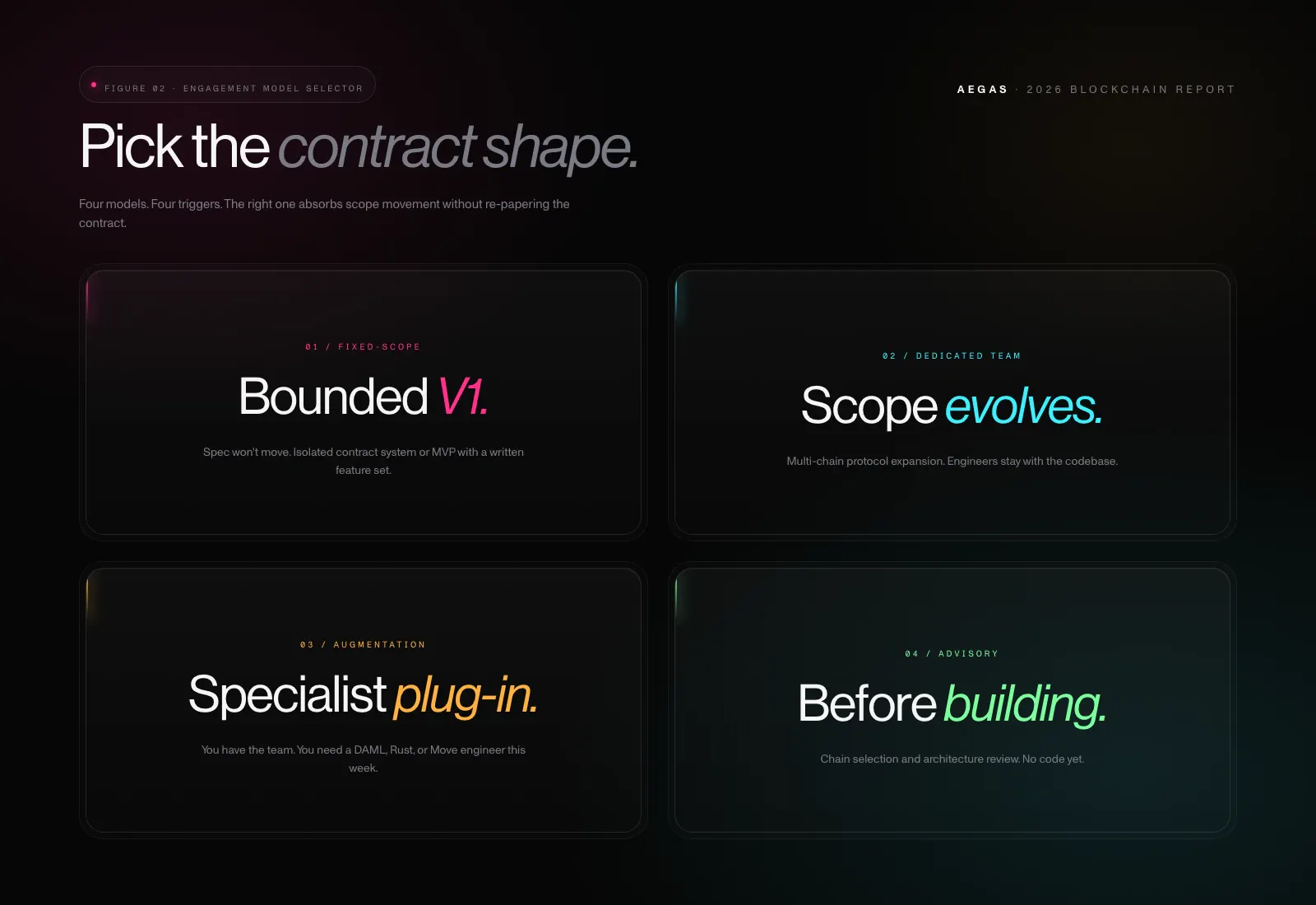
Cost questions ("how much does blockchain development cost?") get the worst answers on the current SERP. ScienceSoft publishes a $50K-$2M range. Unicsoft publishes $50K-$250K+. The Helpware comparison listicle shows $25-$149/hr across vendors. These figures describe the market but give no decision logic. The relevant question is which engagement model fits your project stage, not the dollar range.
Fixed-scope project
Best for: defined deliverable, clear V1 feature set, isolated smart contract system, MVP with bounded scope.
Structure: fixed price and timeline against a written specification. Timeline for a smart contract system typically runs 6-16 weeks depending on audit cycles and integration complexity. The fixed-scope model works when the scope won't change. When requirements evolve mid-engagement – as they frequently do in early-stage protocol development – it generates change-order friction or underspecified deliverables.
Market cost context: vendor rates published on Clutch and independent listicles run $25-$149/hr across the market. Point estimates for Aegas-specific engagements are not published; contact for a scoped proposal.
Dedicated development team
Best for: protocol expansion, multi-chain builds, long-runway product roadmaps where scope will evolve.
Structure: a named team embedded in your product development cycle, scaling headcount with project phases. This model gives the buyer continuity of engineers who understand the codebase, with scope that can expand without formal renegotiation.
First-hand evidence: Aegas's Privex engagement ran this model. An 8-person dedicated team worked across Base and COTI Network over a 2-year engagement from 2024 to 2026. The platform reached $219 million in daily trading volume, $22 billion in platform volume, and 8 million executed trades. A fixed-scope contract would have required renegotiation at least three times as the protocol expanded to COTI, added an AI trading agent launchpad, and built out a custodial wallet solution.
For Web3 startup CTOs evaluating whether to build an in-house team or partner with a dedicated external team, our guide on when a technical partner makes sense covers the trade-offs directly.
Team augmentation
Best for: CTOs who have a core internal team but need specific chain expertise they don't have in-house (e.g., a DAML engineer for a Canton integration, a Rust specialist for a Solana program, a Move developer for a Sui deployment).
Structure: Aegas engineers slot into your existing team under your technical leadership. It is faster to start than a dedicated team engagement and carries no long-term headcount commitment.
Audit-only and advisory retainer
Best for: founders with an internal development team who need external security review, or buyers who need chain selection and architecture advisory before writing a build contract.
Structure: no build work. The engagement produces an architecture recommendation, a chain-selection memo, or a pre-build technical scoping document. Note that security audit reports are a separate engagement performed by specialist audit firms, not by a development partner. This advisory model is the appropriate entry point for buyers who haven't answered the five evaluation questions from the previous section, particularly chain selection and the pre-build technical decisions that sit upstream of your compliance counsel's regulatory analysis.
The timeline question (PAA #5) reduces to scope and engagement model. Any vendor quoting "MVP in 4 weeks" without a scope document attached is using a marketing number, not a delivery estimate.
What is the best blockchain development company for your project in 2026?
"Best" is context-dependent. A firm that is the right choice for a Hedera-native enterprise supply chain project is probably not the right choice for a high-throughput perpetuals DEX on Sonic. The following use-case matrix gives buyers a self-selection model rather than a ranked list.
DeFi perpetuals and high-throughput DEX builds require direct experience with Base, Sonic, or comparable high-throughput EVM chains. The vendor needs to know the specific quirks of each chain's gas model, MEV environment, and liquidity ecosystem. The Privex engagement on Base is the case study most directly applicable here: 8-person dedicated team, two-year runway, $22 billion in cumulative platform volume and $219 million peak daily volume on a perpetuals DEX. Aegas has also delivered fixed-scope perpetuals builds on other EVM L2s; the lessons in those engagements were primarily about chain-selection fit at the point of contract signing, which is covered below.
Institutional RWA settlement and tokenization requires Canton/DAML literacy or ERC-3643 implementation experience, plus an architecture that can accommodate whatever token classification your compliance counsel lands on under MiCA. The vendor's job here is the ONCHAINID identity layer and a contract stack that adapts cleanly once your legal team signs off; the classification call belongs to counsel. The Privex engagement is what sustained institutional DeFi delivery looks like in practice: $22 billion in platform volume over a 2-year dedicated-team engagement, plus multi-chain expansion to COTI and AI-augmented trading tooling.
NFT marketplace and DAO tooling has a broader pool of qualified vendors. Aegas's portfolio includes Gutter Cat Gang, GutterMelo, Gutter Market, Gutter Bots, Gutter Picks, and WaterDAO among 31 named projects. The selection criteria here shift toward UI/UX sophistication and smart contract upgradeability design rather than chain-specific throughput expertise.
Enterprise supply chain and B2B blockchain typically requires Hyperledger Fabric, Canton, or Cosmos SDK experience plus enterprise procurement compatibility (SOC 2, NDAs, fixed-scope contracts, long QA cycles). For real-world examples of how major brands have deployed blockchain in enterprise contexts, see our breakdown of big-brand blockchain cases.
Aegas trust signals for verification: 4.9/5 from 14 verified Clutch reviews; named clients include Sandpiper Holdings (CFO review), Fintellect (CEO review), Intersys AG (CTO review), and Wacomet Water (CEO review) – all verifiable on the Clutch profile. Clutch 2023 Smart Contract Development Award winner. Verified badges on DesignRush (4.7), TechBehemoths (5.0), and GoodFirms (5.0).
The Aegas perspective: what shipping 100+ blockchain projects since 2017 taught us about vendor fit
Aegas perspective. The following section draws on named public portfolio data from Core Markets and Privex, both verifiable at aegas.io/portfolio.
The projects that go wrong aren't usually the technically hardest ones. They're the ones where the buyer selects a vendor for brand recognition or aggregate Clutch score and discovers in week 6 that the team has never shipped on their target chain. At that point the options narrow to a chain pivot (expensive), scope reduction (painful), or a vendor change (more expensive than either).
A fixed-scope perpetuals build Aegas delivered in 2024 is the counter-example. The client came in with a specific EVM L2 requirement, a defined integration dependency, and a hard timeline. Aegas had previously shipped on that L2 with the same integration partner, so the team that delivered the build was the team that had hit that chain's gotchas before. The project shipped in 3 months without a chain pivot. The variable that made that possible wasn't team size or seniority level; it was chain fit at the point of vendor selection. The same engagement is also a reminder that chains can outlive their relevance: by 2026, the L2 that hosted that build had wound down significantly, which is why this section now treats ecosystem health alongside throughput as a chain-selection criterion.
The Privex engagement taught a different lesson about engagement model design. A 2-year dedicated team works because scope is expected to move. The protocol expanded from Base to COTI, added an AI trading agent launchpad, and built custodial wallet infrastructure. None of that was in the original scope. A fixed-scope contract would have required formal renegotiation three times. The dedicated team model absorbed those changes because it was structured for a roadmap that would shift, not a deliverable that wouldn't.
On MiCA and ERC-3643: the buyers who end up refactoring are the ones who treated the legal review as a post-launch task. The regulatory classification itself is your compliance counsel's call, not ours. What a development partner contributes is an architecture that won't lock you in before counsel has spoken. Token standard selection, identity layer design, and disclosure-friendly contract structure all sit at contract design time, and they all need to defer to whatever shape your legal team lands on. The right sequence for any EU-adjacent build is: engage compliance counsel first, get a working classification, then start contract design. Our role on that path is to ship contracts that fit the classification your counsel chooses, not to issue legal opinions ourselves.
Our RWA blockchain development service is built to plug into your compliance counsel's analysis, with ERC-3643 implementation, ONCHAINID integration, and a stack that adapts to whichever MiCA token classification applies to your specific issuance.
Ready to scope your blockchain build? What to prepare before the first call
Every development engagement improves when the buyer arrives with a clear position on five questions. Not every answer needs to be final, but having a working position on each one reduces scoping time and surfaces mismatches before a contract is signed.
1. Target chain and why. Not "we want Ethereum" but "we need EVM-compatible with L2 throughput and Base liquidity" or "we need permissioned interop with DAML for institutional settlement." Chain selection drives stack selection, team composition, and timeline. Buyers who arrive with this undefined add 2-4 weeks to the scoping phase.
2. Token type and regulatory classification. If you're building any EU-adjacent product, get a working position from your compliance counsel before the first vendor call on whether your token is an e-money token, an asset-referenced token, or a utility token under MiCA. This classification determines your whitepaper obligations, reserve asset requirements, and authorization pathway. It is a legal question that needs a legal answer, and it has direct architectural consequences your development partner will need to know from day one. A vendor who skips this question or offers their own legal opinion in place of your counsel's is not the right partner.
3. MVP scope vs. full protocol. Can you define the V1 feature set in writing? A smart contract system with four defined functions has a defensible scope. "A DeFi platform" does not. Vendors who quote without a written V1 specification are quoting the wrong number.
4. In-house technical capability. Does your team have a CTO or lead engineer who can review code, evaluate architectural decisions, and own the repository after launch? If yes, team augmentation or fixed-scope project models work. If no, a dedicated team with embedded technical ownership is the appropriate model.
5. Timeline driver. Is there a hard deadline – a MiCA authorization window, an investor demo, a token generation event – or is scope flexibility possible? The answer determines whether a fixed-scope or dedicated-team model is appropriate and whether a timeline estimate is a constraint or a target.
If you can't yet answer questions 1 or 2, a pre-build scoping engagement with our blockchain consulting team can resolve chain selection and compliance questions before any development contract is signed. For buyers who want to go deeper on implementation planning before engaging a vendor, our blockchain implementation guide walks through the full planning process.
Aegas handles fixed-scope projects, dedicated team engagements, team augmentation, and advisory retainers. Contact us via aegas.io to discuss your build.
About the author: Michael Su is the CEO of Aegas, a blockchain development agency he has led since 2017 through 100+ shipped projects spanning DeFi protocols, RWA tokenization platforms, NFT marketplaces, and enterprise blockchain integrations. He works directly with technical founders and procurement leads to match build requirements to the right chain, team structure, and engagement model.