

TL;DR. Blockchain consulting services cover the scoping and architecture work that determines whether a blockchain project ships on time or stalls after six months of development. A qualified firm validates your use case, selects the right chain (EVM L2, Canton Network, Cosmos SDK, or otherwise), scopes the token standard and identity layer, and produces an integration plan before a single line of production code is written.
Aegas combines that advisory work with delivery under one team, using a four-phase framework called the Aegas Blockchain Engagement Readiness Model. This article explains what each phase covers, what drives cost variation, how long implementation takes from first call to mainnet, and the five evaluation questions that separate firms that ship from firms that write decks.
What does a blockchain consultant do, and how is that different from a blockchain developer?
Blockchain consulting and blockchain development are adjacent but distinct. A consultant scopes the problem: which parts of your business logic actually need to be on-chain, which chain fits your compliance and performance requirements, what token standard handles your transfer restrictions, and what the integration with your existing stack looks like. A developer builds what the consultant specified: smart contracts in Solidity or DAML, protocol deployments on testnet and mainnet, front-end integrations, and API connectors to custody and oracle providers.
The failure mode of pure advisory is specific and repeatable. A strategy engagement produces a detailed deck recommending "an Ethereum-compatible chain with compliance features." The client takes that deck to a separate build team. The build team asks: which EVM L2? Which compliance token standard: ERC-3643, ERC-1400, or bespoke? Does the identity layer use ONCHAINID or a KYC oracle? What is the proxy upgrade strategy? The deck has no answers to these questions. The project freezes for another four to eight weeks while the second firm runs its own scoping exercise, now billed on top of the strategy retainer.
Advisory-only firms produce deliverables. Build-first firms scope and then ship, often at lower total cost because the architecture decisions carry directly into sprint planning. When choosing a blockchain development company, the distinction between advisory-and-hand-off versus advisory-and-build is the most consequential evaluation criterion.
What is the Aegas Blockchain Engagement Readiness Model, and why does every project need one before a line of code is written?
The Aegas Blockchain Engagement Readiness Model is a four-phase framework derived from client engagements in RWA tokenization, institutional settlement infrastructure, and DeFi protocol builds. It structures the pre-build period so that every architecture decision is made deliberately, documented, and defensible before sprint 1.
Phase 1: Use-Case Validation (1–2 weeks)
The first question is not "which chain" but "should this be on-chain at all." Many automation problems are solved more simply with a traditional database and an API. On-chain logic earns its overhead when it provides: (a) settlement finality between counterparties who do not trust a shared intermediary, (b) programmable transfer restrictions enforced at the token layer, or (c) composability with external on-chain liquidity or identity infrastructure.
If none of those conditions applies, a conventional backend is the right answer and a blockchain consultant should say so.
Phase 2: Chain Selection (2–4 weeks)
Chain selection is where projects fail most often when skipped. The decision criteria are not throughput benchmarks in isolation. They are:
- Compliance token support: Does the chain's ecosystem support ERC-3643 and ONCHAINID, or will you build a bespoke compliance module that adds 8–12 weeks to the audit surface?
- Finality model: Institutional delivery-versus-payment requires atomic settlement. Canton Network provides deterministic finality with DAML's privacy model: once the Mediator issues a commit verdict, the transaction is final with zero possibility of chain reorganization. An EVM L2 like Base provides fast block times but probabilistic finality unless you add a confirmation layer.
- Privacy architecture: Canton's sub-transaction privacy and party-based data isolation mean counterparties see only their side of a trade. EVM's transparent state is a regulatory liability for institutional settlement where trade terms are confidential.
- Ecosystem lock-in: Cosmos SDK gives interoperability across IBC-connected chains. Base gives access to the EVM developer market and existing DeFi liquidity. The right answer depends on whether your product is a standalone issuance platform or a component in a broader on-chain ecosystem.
Projects that skip Phase 2 and go straight to building on an EVM chain frequently discover mid-sprint that the compliance token standard they need is not supported by the chain's identity infrastructure, or that atomic DvP settlement requires protocol changes the chain's roadmap does not schedule. The rebuild cost exceeds the scoping cost by a factor of three to five.
Phase 3: Architecture Scoping (1–2 weeks concurrent with late Phase 2)
Phase 3 produces the decisions that go into the Architecture Decision Record (ADR):
- Token standard: ERC-3643 for securities and compliance tokens; ERC-20 for utility tokens. ERC-3643's ONCHAINID integration reduces audit surface because the compliance logic is standardized rather than bespoke.
- Identity layer: ONCHAINID for ERC-3643 deployments; a KYC oracle pattern for EVM chains where on-chain identity is not natively available. The choice affects the gas profile and the transfer agent integration timeline.
- Upgrade strategy: Transparent proxy (OpenZeppelin's TransparentUpgradeableProxy) or UUPS for contracts expected to evolve with regulatory requirements. Immutable contracts suit simpler utility tokens where predictability matters more than upgradability.
- Custody model: MPC wallet (e.g., Fireblocks, Qredo) for institutional clients with sub-custody relationships; hardware security modules for issuers who self-custody. This decision shapes the key management architecture for the entire platform.
Phase 4: Integration Planning (1–2 weeks)
Phase 4 maps the blockchain layer to the client's existing data and operational infrastructure. This is where oracle architecture gets specified (Chainlink for price feeds and proof-of-reserve; custom oracle for proprietary data), legacy system connectors are scoped, and the third-party audit coordination plan is drafted. Aegas coordinates with Hacken, OpenZeppelin, Trail of Bits, Halborn, and CertiK depending on the contract complexity and the client's preferred auditor. Audit coordination must be scoped before sprint 1, not after testnet, because the audit timeline affects mainnet dates.
For enterprise integration scope, Aegas's enterprise blockchain integrations practice covers the full connector and infrastructure layer from Phase 4 onward.
How much does blockchain consulting cost, and what drives the variation?
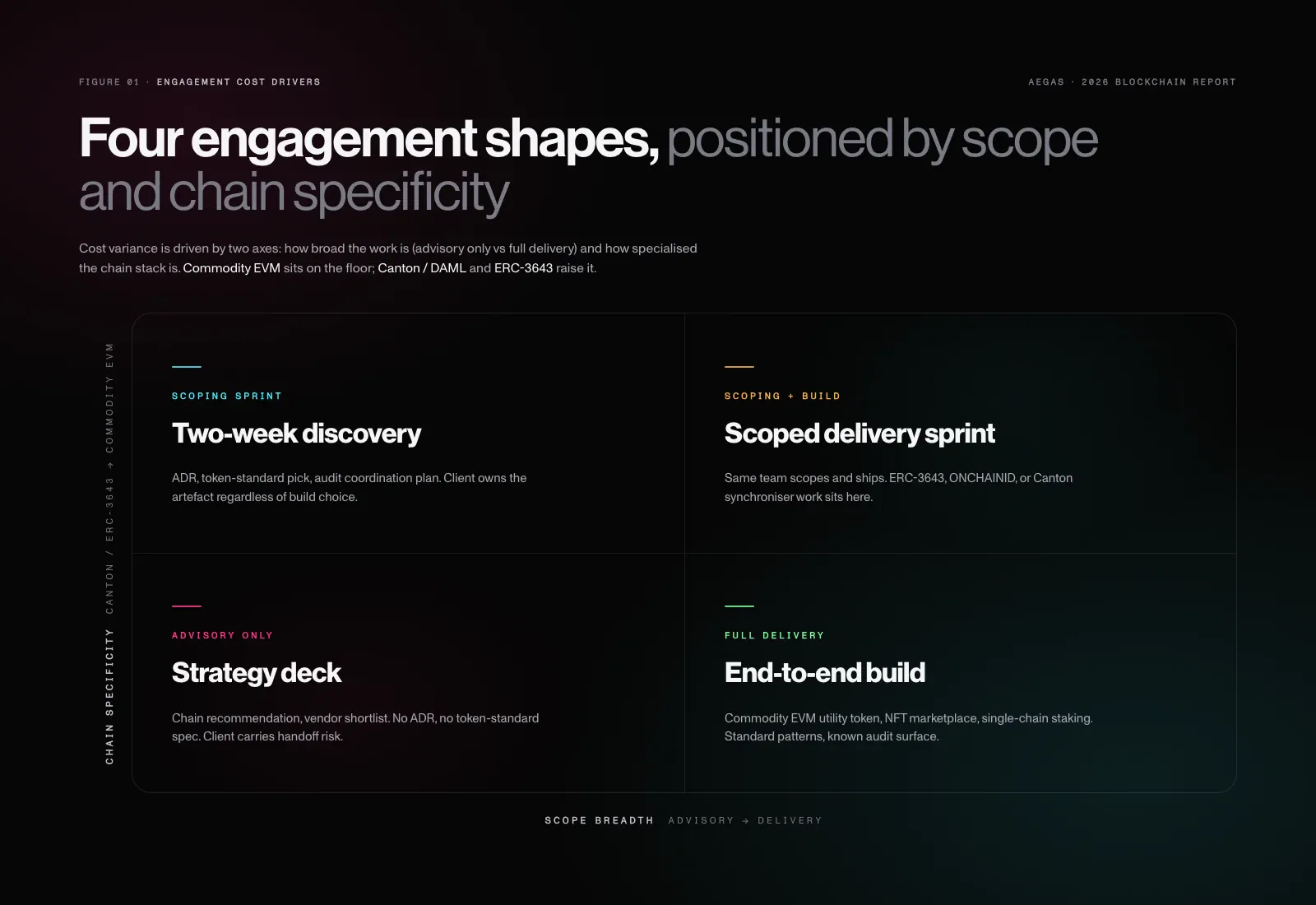
The honest answer: it depends on chain specialization, compliance complexity, and whether you're buying a strategy deck or a scoped architecture.
The cost drivers specific to blockchain engagements are:
- Chain specialization: Canton Network / DAML expertise commands a significant premium over commodity EVM work because DAML contract compilation, Canton synchronizer configuration, and party-based privacy modeling require a specialist skill set with few practitioners globally.
- Compliance token complexity: An ERC-3643/ONCHAINID deployment with a transfer agent integration and KYC oracle is more complex than a standard ERC-20 launch. The identity verification contracts and compliance module alone account for a meaningful share of audit scope.
- Regulatory architecture inputs: MiCA in Europe and evolving SEC guidance in the US create architecture constraints that must be surfaced in scoping. How a token is ultimately classified under those frameworks is your legal counsel's determination, not the engineering team's. The architecture must be built to accommodate whichever classification counsel lands on, and that constraint adds design complexity.
Pure advisory retainers frequently double total project cost because the second firm hired for delivery runs its own scoping exercise. Getting architecture scoping from the delivery team is cheaper end-to-end.
How long does a blockchain implementation take, from first call to mainnet?
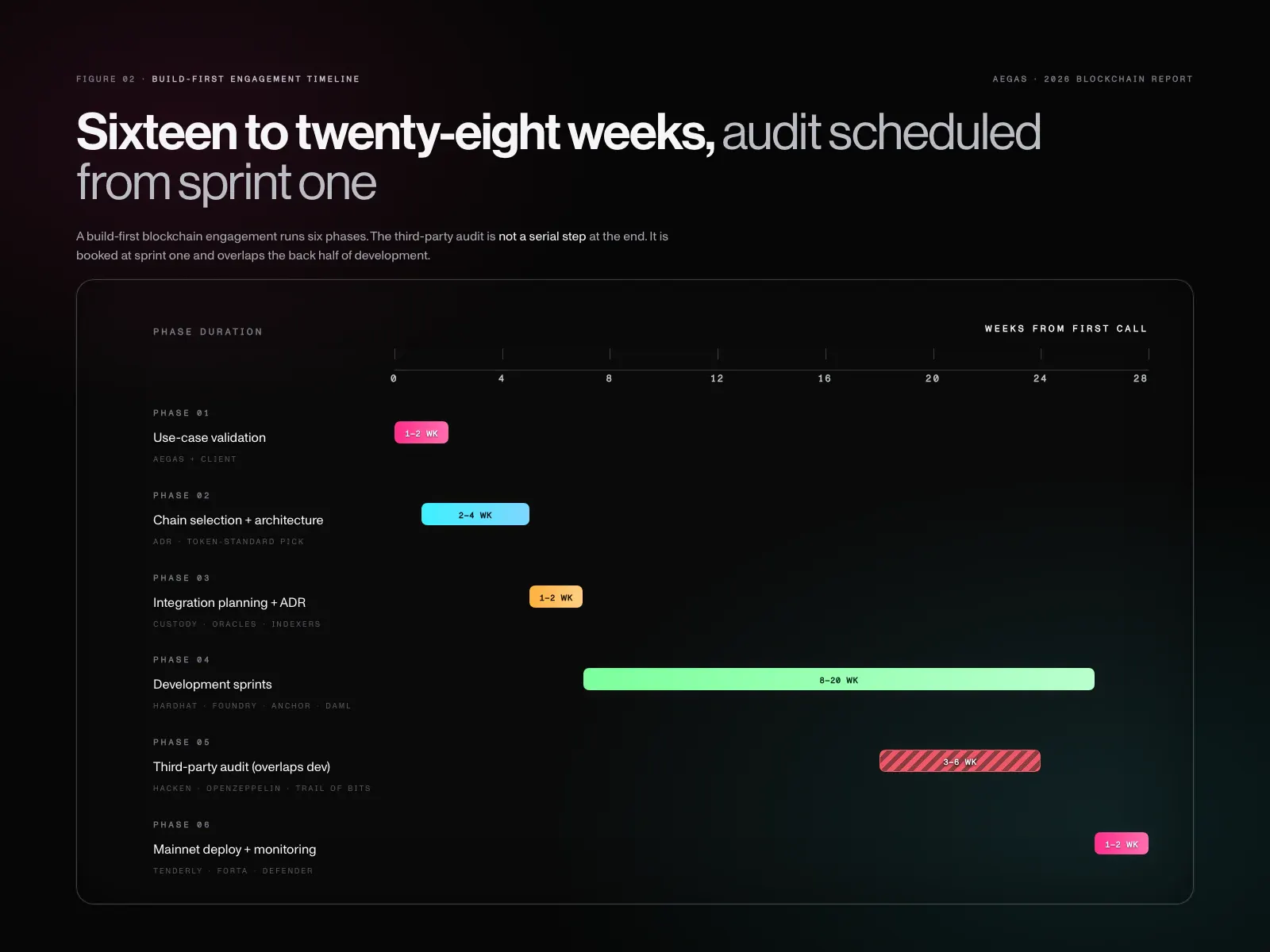
Phase timeline in a build-first engagement:
- Use-case validation: 1–2 weeks
- Chain selection and architecture scoping: 2–4 weeks (can overlap with late Phase 1)
- Integration planning and ADR production: 1–2 weeks
- Development sprints: 8–20 weeks depending on protocol complexity
- Third-party audit: 3–6 weeks (Hacken, OpenZeppelin, or equivalent; schedule this from sprint 1)
- Mainnet deployment and monitoring: 1–2 weeks
Total from first call to mainnet on a mid-complexity RWA tokenization platform: approximately 16–28 weeks.
Mini case study: RWA tokenization scoping
A financial services client approached Aegas to build a tokenized securities issuance platform. The initial requirement was "an EVM chain with compliance features." In Phase 2, chain selection surfaced a specific conflict: the client's transfer agent required atomic delivery-versus-payment settlement for secondary market transfers, which EVM chains do not provide natively without a custom escrow layer.
The options evaluated were: (a) build a custom escrow layer on Base, adding an estimated 6 additional weeks of development and a separate audit engagement; (b) deploy on Canton Network using DAML, which provides atomic DvP settlement natively with deterministic finality that removes the confirmation-layer complexity.
The client's legal counsel confirmed the securities classification, and the architecture team specified ERC-3643 on a Canton-compatible EVM interface for the token layer, with DAML models handling the settlement logic. ONCHAINID was chosen over a bespoke KYC oracle because the transfer agent already had an ONCHAINID integration path in development.
Choosing Canton over Base eliminated the custom escrow build and its audit overhead. The integration plan was delivered at the endat end of week 4. Development began in week 5.
For Canton-specific architecture considerations, the Canton Network development practice at Aegas covers the DAML model and synchronizer setup in detail.
How do I choose a blockchain consulting company, and what questions actually separate delivery firms from deck-writers?
Five concrete evaluation criteria:
1. Chain-specific production experience
Ask for named chains and named token standards shipped, not "multi-chain expertise." A firm that has deployed ERC-3643 on a live issuance platform knows the compliance module deployment sequence, the ONCHAINID claim topic registry setup, and the gas profile at scale. Generic "Ethereum experience" is not the same thing.
2. Named token standards and protocol patterns
Can the firm describe the difference between ERC-3643 and a bespoke compliance module in two sentences? Can they explain when UUPS proxy is preferable to a transparent proxy, and why? Technical specificity here separates architects from integrators.
3. Third-party audit coordination record
A firm that ships contracts without coordinating third-party audits is a liability. Ask which audit firms they have worked with (Hacken, Sherlock, OpenZeppelin, Trail of Bits, Halborn, CertiK) and at what stage audits enter the delivery timeline. Aegas coordinates audits from the architecture scoping phase so the audit window is reserved before the build starts.
4. Reference calls, not deployment addresses
Many production blockchain deployments are NDA-bound or the projects have since wound down. Asking "give me your deployment address" is not a reliable vendor test. The meaningful signal is a reference call with a former client's technical lead and chain-specific production gotchas: "What broke on testnet? What changed in the integration architecture between scoping and mainnet?"
5. Sprint-based delivery with milestone billing
Time-and-materials engagements with no milestone gates are how strategy decks turn into open-ended retainers. A delivery-oriented firm bills against milestones: ADR signed off, testnet deployment completed, audit started, mainnet deployed. That structure aligns incentives.
Red flags to walk away from: vague platform lists with no named chains or standards; no named engineers on the website; audit claims without named third-party firms; a consulting retainer with no defined path to a delivery team.
Third-party verifications on Clutch, DesignRush, Goodfirms, and TechBehemoths provide independent confirmation of client satisfaction, but they are a floor check, not a replacement for a technical reference call.
What blockchain use cases actually warrant consulting, and where do RWA tokenization and institutional settlement fit in 2026?
Not every blockchain project needs a full four-phase engagement. Use-case complexity determines consulting intensity.
High consulting value (these projects stall without proper scoping):
- RWA tokenization (securities, real estate, trade finance): requires ERC-3643 or equivalent, ONCHAINID identity layer, transfer agent integration, and chain selection that accommodates DvP settlement semantics.
- Institutional settlement infrastructure: requires Canton Network / DAML or equivalent privacy-preserving architecture; transparent EVM state is architecturally incompatible with institutional settlement confidentiality requirements.
- Cross-border payment rails: finality model, correspondent banking integration, and regulatory architecture across multiple jurisdictions each add scoping complexity.
- On-chain KYC / identity infrastructure: ONCHAINID claim topic registry design, claim issuer selection, and oracle architecture require protocol-level decisions.
Lower consulting intensity (standard patterns apply):
- Utility token launches: standard ERC-20, well-understood audit surface.
- Basic NFT marketplaces: ERC-721/1155 with an existing marketplace contract template.
- Single-chain staking contracts: audited reference implementations exist.
The 2026 institutional wave
The tokenized RWA market reached $19.3 billion in market capitalization by the end of Q1 2026, a 256% increase from the $5.42 billion recorded at the start of 2025 according to CoinGecko's RWA Report 2026. The tokenized U.S. Treasury market reached $14 billion in Q1 2026, with BlackRock, Ondo Finance, Hashnote, and Franklin Templeton collectively accounting for approximately 80% of that market. ERC-3643 has enabled over $32 billion in tokenized assets across 180+ jurisdictions as of early 2026, with institutional adopters including DTCC, Apex Group, Invesco, and Franklin Templeton.
What is largely absent from competitor consulting pages is architecture-level coverage of ERC-3643/ONCHAINID deployment patterns and Canton Network institutional settlement. Those two areas represent the highest-complexity, highest-value scoping work in 2026, and they require delivery teams who have actually shipped on both protocol stacks.
For a detailed breakdown of RWA tokenization architecture choices, the Aegas RWA blockchain development practice covers the ERC-3643 issuance stack end-to-end.
Canton Network's DAML privacy model is worth naming specifically: DAML contracts define which parties see which fields in a transaction. Sub-transaction privacy means a counterparty in a two-leg settlement sees only their leg. This is not a configuration option in EVM; it is a fundamental property of the DAML runtime that makes Canton the correct chain for institutional settlement where trade terms are contractually confidential between counterparties.
The Aegas perspective: what build-first blockchain consulting looks like in practice
Aegas perspective. Aegas does not deliver strategy documents that a second team later translates into architecture. The engineers who run the scoping phases are the engineers who write the contracts. That means architecture decisions made in week 2 are reflected in the sprint plan in week 5, not rediscovered by a new team in week 12. The ADR produced at end of scoping is versioned in Git and handed to the client regardless of whether the engagement continues, which means the client owns the architecture decisions and can take them to any build team.
We have observed two failure modes repeatedly in engagements that came to us after a pure-advisory phase:
Failure mode 1: Chain selected on throughput benchmarks without validating compliance token standard support. A client was mid-build on a chain that did not have a working ONCHAINID implementation in its ecosystem. The compliance module had to be built bespoke, adding 10 weeks and a separate audit engagement.
Failure mode 2: Integration architecture scoped without oracle latency constraints from the client's existing data layer. A client's price feed came from an internal risk system with a 15-second refresh interval. The DeFi protocol design assumed sub-second oracle updates. The conflict was not caught until the oracle integration sprint, requiring a protocol redesign.
Both failure modes are caught in Phase 2 and Phase 4 of the Aegas Blockchain Engagement Readiness Model when those phases are run by the delivery team.
"The scoping phase is not overhead. It is the cheapest insurance a client can buy against a mid-build rearchitecture." — Michael Su, CEO, Aegas, May 2026
For enterprise integration scope, the enterprise blockchain integrations service page covers connector architecture, legacy system integration, and the infrastructure layer that Phase 4 produces.
How to start a blockchain consulting engagement with Aegas
The entry path is three steps:
Step 1: Initial scoping call (free, ~60 minutes) Validate whether your use case warrants on-chain logic, identify chain candidates, and confirm whether existing standards (ERC-3643, DAML models) apply to your problem. Aegas asks about your compliance requirements, counterparty trust model, and existing data infrastructure before recommending anything.
Step 2: Two-week discovery sprint This sprint produces four deliverables:
- Architecture Decision Record (ADR): Chain selection rationale with named alternatives and rejection reasons. Versioned in Git; you own it.
- Token standard recommendation: ERC-3643 vs. ERC-20 vs. DAML model, with compliance module design.
- Integration architecture diagram: Oracle design, custody model, legacy system connectors, API surface.
- Audit coordination plan: Named third-party audit firm, estimated audit window, scope boundary document.
The ADR format ensures that the decisions survive any team or vendor change. If you decide not to continue with Aegas after the discovery sprint, you take the ADR with you.
Step 3: Sprint-based development with milestone billing Development begins the week after the ADR is signed off. Milestones are: testnet deployment, security audit start, mainnet deployment, and monitoring handoff. Each milestone triggers a defined payment and a defined deliverable.
To start a scoping conversation, contact the Aegas team. For a full picture of enterprise integration scope available post-scoping, the enterprise blockchain integrations service covers the connector and infrastructure layer.
Advisory vs build-first engagement
| Dimension | Pure Advisory Engagement | Build-First Engagement (Aegas model) |
|---|---|---|
| Primary deliverable | Strategy document, chain recommendation, vendor shortlist | Architecture Decision Record, token standard spec, integration diagram, audit coordination plan |
| Team composition | Strategy consultants, possibly a part-time architect | Senior engineers who will build the architecture they specify |
| Timeline | 4–8 weeks for strategy phase | 2–4 weeks scoping; development begins immediately after |
| Risk transfer | Client assumes delivery risk when handing off to a build team | Scoping team is the build team; no handoff, no translation loss |
| Typical engagement spend | $15,000–$60,000 strategy retainer, then separate build contract | Scoping sprint bundled into overall engagement; lower total cost |
| When to use | If you genuinely need a vendor-neutral second opinion before committing to a build partner | If you want the architecture decisions made by the team that will execute them |
About the author: Michael Su is the CEO of Aegas, a blockchain development agency he has led since 2017 through 100+ shipped projects spanning DeFi protocols, RWA tokenization platforms, NFT marketplaces, and enterprise blockchain integrations. He works directly with technical founders and procurement leads to match build requirements to the right chain, team structure, and engagement model.