


TL;DR. Blockchain integration services means connecting a blockchain layer to existing ERP, CRM, custody, or financial back-office systems without replacing them. The hard part is never the chain. It is the integration layer that binds on-chain state to live enterprise data flows: identity federation between blockchain party models and enterprise IdPs, state-reconciliation middleware between immutable contract state and mutable ERP fields, and settlement-buffer logic between on-chain finality and the timing assumptions baked into legacy back-offices. Chain choice and integration pattern follow from your legacy stack type and finality requirements, not from chain popularity.
This article covers the integration patterns Aegas uses across permissioned institutional networks (Canton Network / DAML) and public EVM environments, the five failure points that surface most consistently in production, and how RWA tokenization scales every one of those failure modes into the highest-stakes integration scenario an enterprise can ship. The unifying claim from shipping these integrations is straightforward: when an enterprise blockchain project fails in production, the chain handled settlement correctly; the integration layer is where the project went wrong.
What are blockchain integration services, and how do they differ from a PoC?
Blockchain integration services is the architectural work that binds on-chain state to live enterprise data flows. That definition matters because it separates production integration from a proof-of-concept, and most enterprise blockchain engagements fail at exactly that boundary.
A PoC is isolated: it runs on testnet, uses synthetic data, has no legacy coupling, and proves a concept without touching your actual systems. A production integration engagement is different in kind. It requires production data flows, identity federation, key custody strategy, audit-trail alignment between on-chain events and off-chain records, and a state-reconciliation layer that handles the mismatch between how blockchains model state and how ERP systems model state.
The first question Aegas asks at the start of every integration engagement is: what latency and finality guarantees does your back-office actually need? That single question usually determines whether a permissioned network or a public chain is the right architecture, which integration pattern to use, and how much custom middleware the project will require.
The production-outcome bar for an institutional blockchain integration is high. Institutional mandates require T+0 or near-T+0 finality, KYC-gated asset transfers, and audit trails that satisfy both internal compliance and external regulatory reporting. Building to that bar is the difference between an integration that clears legal review and one that does not.
For a broader view of how Aegas approaches this work as a blockchain development company, the engagement model starts with the same question: where does the business need on-chain settlement, and what does that mean for the existing system landscape?
How do you integrate blockchain with an ERP or CRM system?
Three integration patterns account for nearly every production enterprise blockchain deployment we have worked on. The right choice depends on the legacy stack type, the required settlement finality, and the compliance fit.
Pattern 1: Direct API / Ledger API binding. For institutional permissioned stacks built on Canton Network and DAML, the integration point is the DAML Ledger API. This is not an EVM concept. DAML uses an explicit party model: each participant has a named party with specific visibility into contracts on the ledger.
Integrating a Canton node into an enterprise back-office requires mapping DAML party namespaces to enterprise identity provider namespaces (Entra ID, Okta), which has no equivalent in EVM address-based identity. Chainlink's Runtime Environment (CRE) provides a useful abstraction layer for EVM-based legacy integration, but it cannot be applied to Canton: the party model, two-phase commit across sync domains, and immutable contract state require explicit namespace and party-model management from day one.
Pattern 2: Event-driven message-bus bridge. For ERP event streams – SAP ERP, Oracle Financials – an event-driven bridge gives the cleanest decoupling between the blockchain layer and the legacy system. Aegas defaults to RabbitMQ for this pattern: routing-rich, lower operational overhead, and well-matched to the request-response and acknowledgement semantics most ERP integrations need. Kafka is the right call when scope demands very high throughput streaming, durable replay of long event logs, or Kafka-Connect bindings the client already operates. Either way: the ERP emits events; a consumer service translates them to on-chain transactions; on-chain confirmations emit back through the same bus. This pattern handles volume, but it introduces latency that back-office systems must be designed to absorb, not surface as an error.
Pattern 3: REST oracle adapter. For legacy custody systems and transfer-agent platforms, a REST oracle adapter provides the simplest path to on-chain data availability. This is the pattern for external data feeds: custody valuations, FX rates, collateral prices.
Aegas Enterprise Integration Pattern Matrix
| Stack Type | Recommended Pattern | Settlement Finality | Compliance Fit | Typical Integration Latency |
|---|---|---|---|---|
| SAP ERP (S/4HANA) | RabbitMQ event bridge (Kafka if very high throughput) | Near-real-time (seconds) | Audit trail via hash anchoring | 50–300ms event lag |
| Oracle Financials | RabbitMQ event bridge or REST API binding | Near-real-time | ISO 20022 context; payment-message standard determined by client ops team | 50–300ms event lag |
| Legacy custody system | REST oracle adapter | T+0 possible with settlement buffer | KYC/AML feeds via ONCHAINID | Sub-second for read; 2–15s for confirmed write |
| Transfer-agent platform | REST oracle adapter + DvP orchestration layer | T+0 via Canton atomic settlement | ERC-3643 / ONCHAINID for investor-identity compliance | 5–30s depending on sync-domain topology |
| Permissioned institutional network (Canton/DAML) | Direct DAML Ledger API binding | Two-phase commit, deterministic | Party-explicit identity, explicit disclosure model | Sync-domain dependent; 1–10s typical |
| Public EVM (Base, Ethereum L1) | Chainlink CRE / direct RPC | Probabilistic (EVM finality) | Pseudonymous; KYC layer must be added above chain | Block time + confirmation depth |
The matrix below maps legacy stack type to recommended integration pattern, with settlement finality and compliance trade-offs included.
For our enterprise blockchain integration services, the pattern selection happens during the architecture phase. Getting it wrong in that phase costs far more to fix than getting it right upfront.
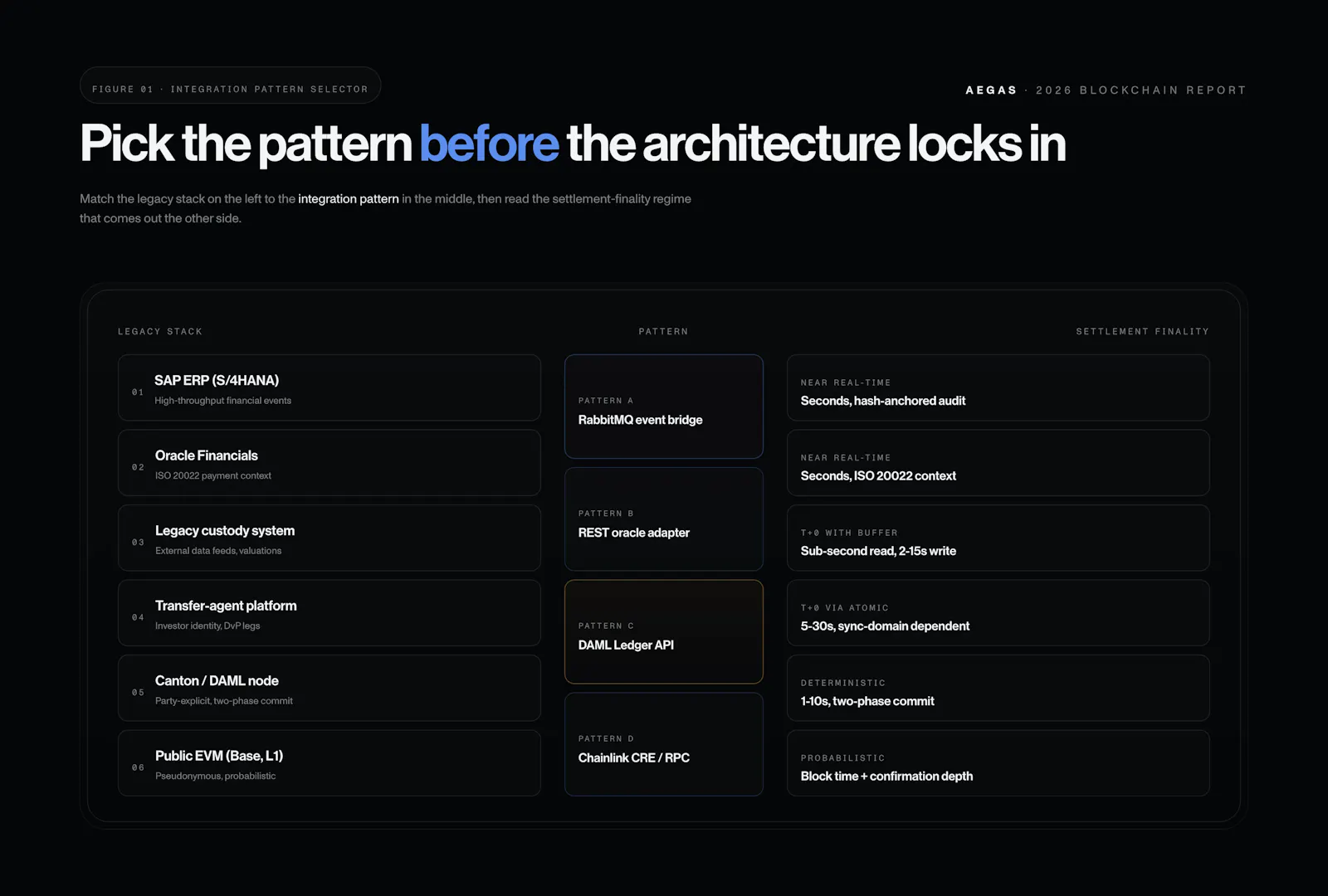
Integration pattern selector: match your legacy stack type to the right blockchain integration architecture before design commitments lock in
What is the difference between permissioned and public blockchain for enterprise integration?
Public chains like Ethereum L1 and Base give open settlement finality with pseudonymous identity. Any address can observe transaction data, subject to on-chain privacy patterns. Permissioned networks – Canton Network, Hyperledger Fabric, Corda – give selective data visibility with party-explicit identity, but they require explicit identity federation to enterprise IdPs and impose different state models.
Canton Network specifically uses a sync domain model with two-phase commit for atomic settlement. Party allocation in Canton is not the same as an EVM address: a Canton party is a named, credentialed participant whose view of the ledger is limited to contracts they are a stakeholder on. An integration that works correctly for Party A's view of a contract is entirely invisible to Party B until Party A explicitly discloses it. This concept does not exist in EVM environments, and it breaks naively-ported integration assumptions that EVM-experienced teams sometimes carry into Canton projects.
For RWA tokenization work, Canton's selective data visibility is an architectural feature, not a limitation. It means a bond issuer can disclose settlement details to the transfer agent and the custodian without broadcasting those details to the broader network. The tokenized RWA market exceeded $36 billion (excluding stablecoins) as of late 2025, per Canton Network's State of RWA Tokenization report, with 1–3% pricing gaps across fragmented chains and 2–5% friction moving capital cross-chain already creating measurable inefficiency. Per RedStone's March 2026 case study, Canton itself now hosts in excess of $8 trillion in tokenized assets across U.S. Treasury repos, syndicated loans, money market funds, and physical commodity settlements, with daily volume around $350 billion and institutional participants including Goldman Sachs and Broadridge. Canton's atomic settlement model is the direct response to the fragmentation problem.
Regulatory context shapes architecture choices here: MiCA, EU settlement directives, and US securities law all affect what data can be on-chain and in what form. Classification decisions on what qualifies as a security or regulated financial instrument belong to the client's legal counsel, not to us. Aegas builds to whatever classification counsel arrives at.
For institutional settlement on Canton, see our Canton Network development practice.
Do you need to replace existing systems to add blockchain?
No. Every production blockchain integration Aegas has shipped uses an additive architecture, not a replacement. The winning pattern is consistent: sensitive PII and mutable ERP fields stay in existing systems; only cryptographic commitments, settlement events, and tokenized asset state write to chain.
The "Trust Paradox" is the right framing for any CTO evaluation. Legacy infrastructure creates the exact need for blockchain's trust guarantees (immutable audit trail, deterministic settlement, cryptographic proof of state), yet that same legacy infrastructure is the primary integration barrier. Reconciling that tension is what integration engineering actually involves.
The specific technical problem behind the Trust Paradox is this: DAML's archive-and-recreate contract state model is fundamentally incompatible with mutable ERP field updates. In ERP systems, updating a record means modifying a row. In DAML, you archive the existing contract and create a new one that supersedes it. Every Canton integration we have shipped required custom state-reconciliation middleware to translate between these two paradigms. This is not an edge case – it is a core architectural requirement of any Canton/ERP integration.
The practical implication: plan for state-reconciliation middleware as a first-class component of the integration architecture, not a layer added later. Teams that treat it as an afterthought spend the last 30% of the project timeline retrofitting it.
What are the main failure points in enterprise blockchain integration?
Aegas perspective – Michael Su, CEO of Aegas (2026-05-26). From shipping Canton Network integrations for institutional clients, we have seen the same five failure points appear across engagements. The industry baseline is grim: Constellation Research finds that between 80% and 90% of enterprise blockchain projects never proceed beyond proof of concept or pilot, and Errna's analysis of enterprise DLT deployments attributes 65% of pilot failures to insecure or non-scalable data bridge architectures rather than the core chain. Our experience confirms the direction of that number. The chain handles settlement correctly. The integration layer is where institutional projects go wrong.
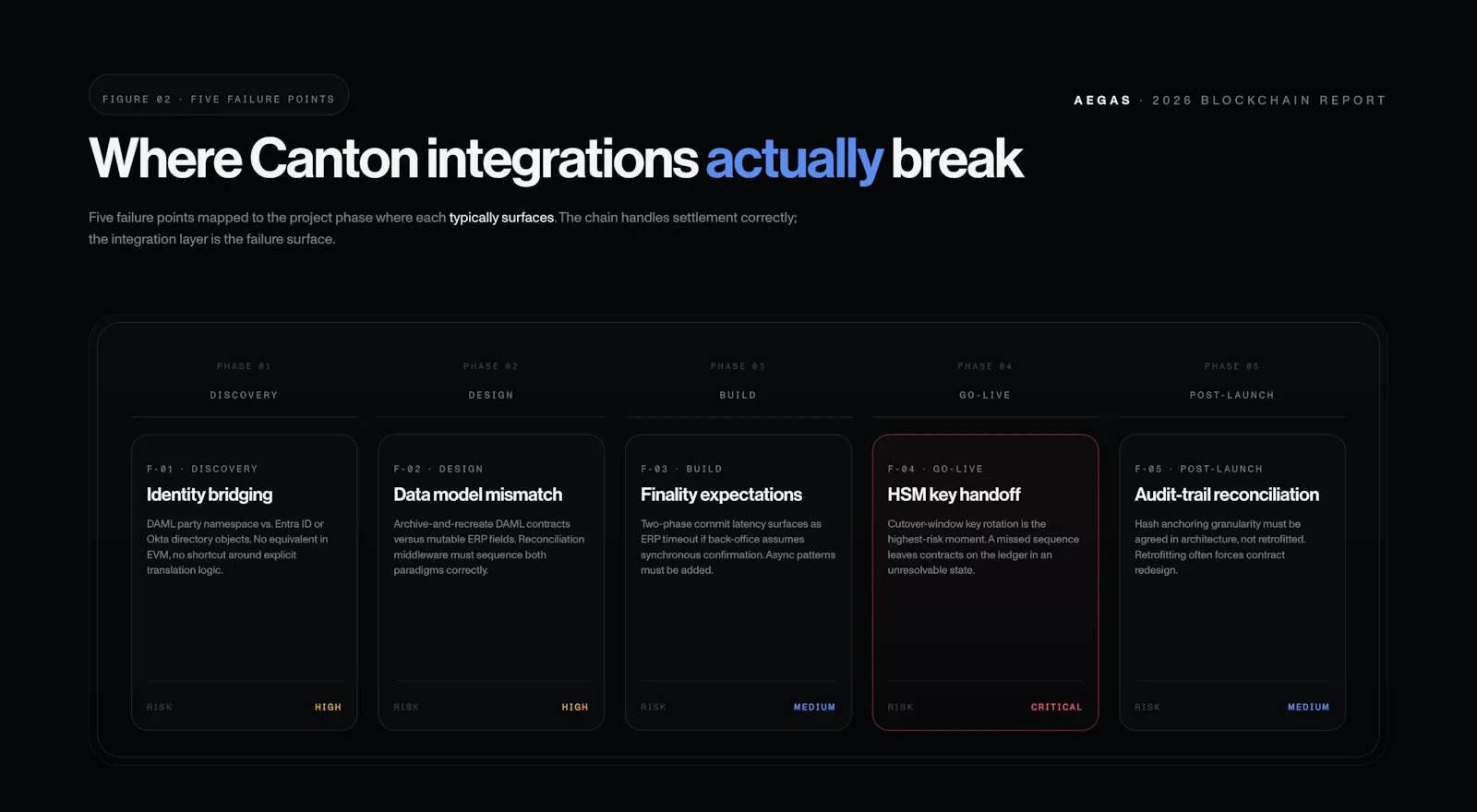
Five production failure points mapped to the project phase where each typically surfaces, from discovery through post-launch
1. Identity bridging. Canton's DAML party-allocation model and enterprise IdPs like Entra ID or Okta use fundamentally different namespace models. A DAML party is not a directory object. Mapping between them requires explicit translation logic, and if the enterprise changes identity providers mid-project (a common procurement event), party migration must be planned and executed against live contracts. Teams that treat identity bridging as a later concern typically encounter it as a production blocker at go-live.
2. Data model mismatch. DAML's archive-and-recreate state model versus mutable ERP fields is the most consistent source of integration rework across all engagements. The middleware layer must continuously reconcile two fundamentally different state paradigms. Any ERP update that would be a simple field modification becomes an archive-and-recreate cycle on the Canton side, with the middleware responsible for sequencing those operations correctly.
3. Transaction finality expectations. Enterprise back-office systems are designed around synchronous confirmation: submit a transaction, receive a synchronous success or failure response. Canton's two-phase commit across sync domains introduces latency that must be absorbed at the middleware level. If that latency surfaces to the back-office as a timeout or error, existing error-handling logic triggers incorrectly. The integration layer must implement an async confirmation model with back-office-compatible acknowledgment patterns, which often means re-architecting assumptions baked into existing ERP workflows.
4. Key management handoff. The highest-risk moment in any Canton deployment is key migration at the HSM boundary during live integration cutover. Canton's DAML developer guide (updated March 2026) lists HSM-backed key storage and party migration as core deployment considerations, but the cutover window itself requires a carefully sequenced key rotation that most project timelines underestimate. A missed sequence in HSM key handoff can leave contracts on the ledger in an unresolvable state. Plan this as a dedicated workstream with a defined rollback procedure, not a task within a broader deployment sprint.
5. Audit-trail reconciliation. On-chain event hashes must be validated against off-chain ERP records to produce a reconciled audit trail that satisfies both internal compliance requirements and external regulatory reporting. The hash anchoring strategy – which events get anchored, at what granularity, with what off-chain counterpart – must be agreed during the architecture phase. Retrofitting a hash anchoring strategy onto a completed integration is expensive and often requires contract redesign.
The five failure modes above are first-hand observations from Michael Su, CEO of Aegas, drawn from Canton Network institutional engagements shipped since 2022 (attribution dated 2026-05-26).
How does RWA tokenization change the blockchain integration problem?
RWA tokenization is the highest-stakes version of the integration problem this article has been describing. Every failure mode in the previous section applies, and the legacy-stack surface area expands: instead of integrating a chain with one ERP, the project has to bind the tokenization platform to legacy custody systems and transfer-agent back-offices at the same time, with deterministic settlement finality as a hard requirement, not a nice-to-have. The 5 failure points scale with the stakes.
That makes RWA the clearest worked example of why the integration patterns and failure modes above matter. The specific workflow is DvP (Delivery versus Payment) orchestration: atomic delivery of tokenized securities against simultaneous payment settlement, with T+0 finality via Canton's atomic settlement model. On top of that, the investor-identity compliance layer – ONCHAINID for ERC-3643 compliant token issuance – must feed back into custody system KYC records. A new investor onboarded via ONCHAINID needs to appear in the custody system's KYC database, or the transfer agent cannot confirm the settlement leg. That single requirement compounds failure mode #1 (identity bridging) and failure mode #5 (audit-trail reconciliation) from the previous section into a single workstream.
The integration challenge unique to this architecture is connecting a Canton-issued tokenized bond to a legacy T+1 custody system that cannot accept T+0 finality natively. The custody system expects a T+1 settlement confirmation. The Canton atomic settlement produces T+0. The integration layer must implement a settlement buffer: hold the on-chain confirmation, produce a synthetic T+1 acknowledgment to the custody system, and reconcile the two states without creating a position discrepancy. This is failure mode #3 (transaction finality expectations) at its most extreme: probabilistic-finality EVM chains are structurally closer to T+1 than Canton's deterministic atomic model, which is why EVM-only shops have not encountered this problem.
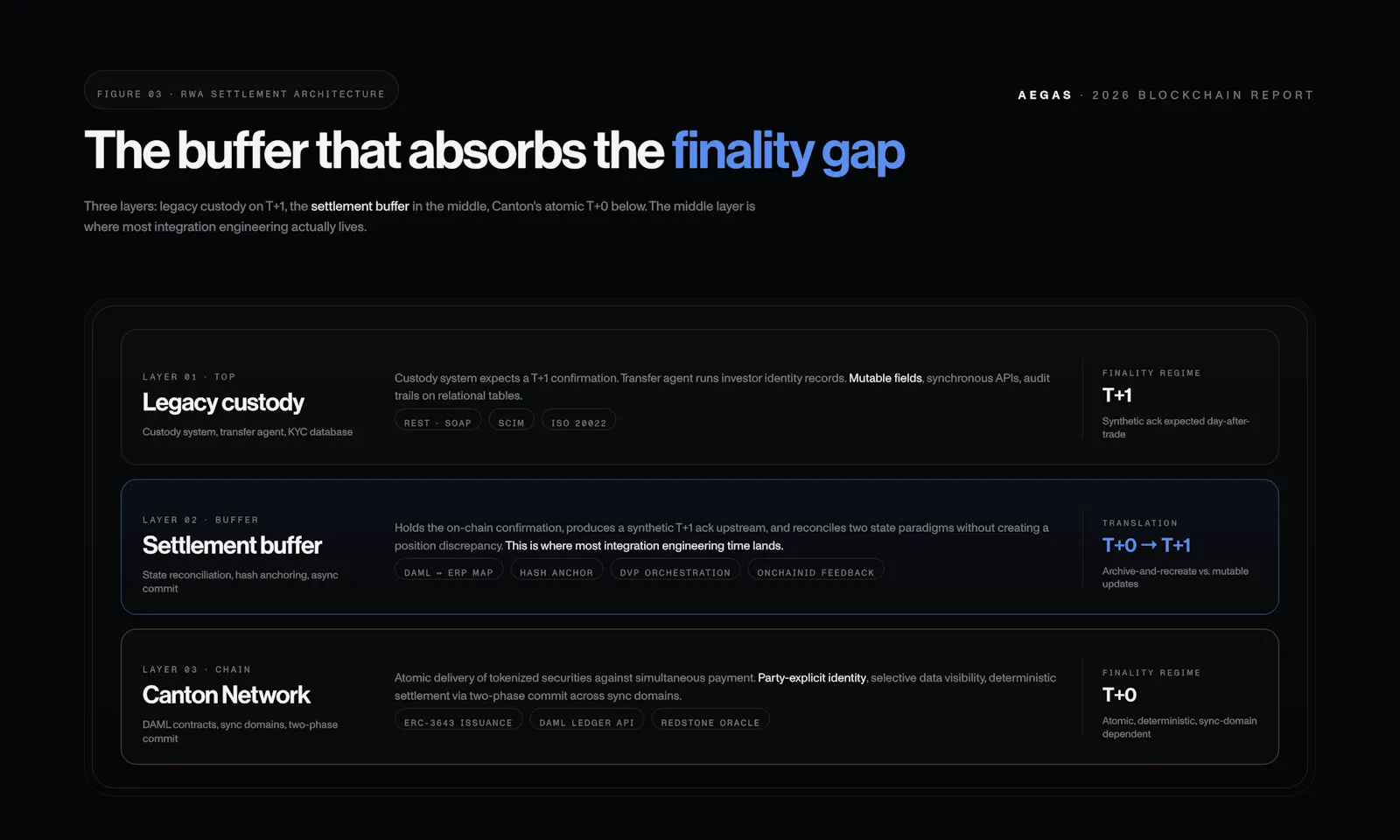
RWA settlement architecture: the buffer layer absorbs the finality gap between T+1 legacy custody and T+0 Canton atomic settlement without creating position discrepancies
The freshness signal here is concrete. In March 2026, RedStone became the first decentralized oracle provider to deploy production RWA oracle infrastructure on Canton Network using a Daml-native architecture. Standard EVM oracle configurations – including Chainlink's push/pull models – cannot be lifted directly onto Canton because Canton's party-specific data visibility and immutable contract model require oracle data to be delivered within the DAML contract model, not as an external call. RedStone built the architecture from first principles to satisfy Canton's requirements. That deployment confirms that the oracle data layer for institutional RWA workflows on Canton is no longer theoretical.
Canton's April 2026 network developments confirm the institutional momentum: TRM Labs compliance integration and WalletConnect now live on Canton add compliance screening and wallet connectivity to the network's production stack. Each new component is one more legacy interface the integration layer has to absorb without breaking the audit-trail reconciliation behind it.
Treat the RWA case as the upper bound for what enterprise integration scope looks like. The patterns from the matrix above still apply: REST oracle adapter for custody data, DAML Ledger API binding for the Canton leg, settlement-buffer middleware to absorb the finality-regime gap. The difference is that every failure mode now has financial-settlement consequences attached, which is why budget envelopes and timelines shift accordingly (covered in the next section). For RWA tokenization platform development, including ONCHAINID, ERC-3643 compliance layers, and custody system integration, see our RWA blockchain development practice.
How long does enterprise blockchain integration take, and what does it cost?
Realistic ranges from Aegas engagements, by phase:
- Architecture and design: 4–8 weeks. This phase produces the integration pattern selection, identity federation design, state-reconciliation approach, and key management plan.
- PoC to integration bridge: 8–16 weeks. Building and validating the core middleware layer, including state-reconciliation logic and identity federation components.
- Full permissioned network deployment with legacy coupling: 6–12 months. This includes the full integration stack, security review and third-party smart-contract audit coordination (Hacken, OpenZeppelin, or equivalent), and production go-live.
For institutional mandates, Prosigns publishes architecture engagements at $80K–$250K, permissioned network deployments at $800K–$2.5M, and full tokenization platform builds at $1M–$3M. Aegas does not publish equivalent tiers, but these ranges reflect the actual scope of institutional integration work accurately.
The two variables that drive cost above all others are identity federation complexity and settlement finality requirements. A Canton integration for a client whose enterprise IdP is fully SCIM-compatible and whose custody system accepts T+0 finality is a materially different cost envelope from an engagement where identity federation requires custom party migration tooling and the custody system needs a settlement buffer layer.
The hidden cost that every budget underestimates is the state-reconciliation middleware between DAML contract state and mutable ERP systems. It is consistently the line item that goes longest in Canton engagements: invisible at scoping, dominant once the first production data flow hits the integration layer, and the most common reason a project that looked fixed-fee at signing ends up needing a change order. We scope it as a dedicated workstream now, with its own architect owner, rather than as a sub-task under the chain integration line.
For a more detailed view of how these engagements are structured, or to discuss a specific integration architecture, our enterprise blockchain integration services page covers the engagement model.
The Aegas perspective: what production Canton integrations taught us about enterprise blockchain
Two integration capabilities differentiate Aegas from the generalist IT consulting firms that dominate the "blockchain integration services" SERP: Canton Network / DAML institutional settlement integration, and RWA tokenization pipelines that connect tokenized assets to legacy custody and transfer-agent back-offices.
The single biggest lesson from shipping these integrations is simple. The chain handles settlement correctly. Canton's atomic settlement model, two-phase commit, and selective data visibility do what they are designed to do. The integration layer is where institutional projects fail, consistently, across all five failure modes described above.
The Aegas Enterprise Integration Pattern Matrix in this article is the practical output of those engagements: a decision framework for matching legacy stack type to the right integration pattern before architecture commitments are made, not after the first production data flow reveals a mismatch.
Smart-contract coverage on RWA tokenization work is coordinated with third-party audit firms: Hacken, OpenZeppelin, and equivalent providers, depending on the protocol's risk profile and the client's audit requirements. Aegas does not self-audit its own contracts. External audit coordination is scoped as a distinct workstream in every production tokenization engagement.
The work is verified against independent standards. Aegas's delivery track record across 100+ shipped projects is visible through Clutch, DesignRush, Goodfirms, and TechBehemoths.
For institutional blockchain consulting that goes beyond this article, see our blockchain consulting services coverage of the broader engagement model.
If you are evaluating vendors for an enterprise integration, the differentiating question is not "have you deployed a smart contract" but "have you shipped a Canton integration that required custom state-reconciliation middleware between DAML contract state and a live ERP system." Reference calls, documented production gotchas, and chain-specific delivery evidence are the actual signal. Many projects are NDA-bound; the conversation itself surfaces the depth of experience.
Last updated: May 18, 2026
About the author: Michael Su is the CEO of Aegas, a blockchain development agency he has led since 2017 through 100+ shipped projects spanning DeFi protocols, RWA tokenization platforms, NFT marketplaces, and enterprise blockchain integrations. He works directly with technical founders and procurement leads to match build requirements to the right chain, team structure, and engagement model.