

TL;DR. Private blockchain development, also called permissioned blockchain development, means building a distributed ledger where participant identity is gated, write access is controlled, and no public mempool exists. Regulated industries choose it when they need finality predictability, data confidentiality, and an auditable chain of record that doesn't expose transaction data to the open internet. The dominant platforms in 2026 are Canton Network (DAML), Hyperledger Fabric 3.x, Corda 5, and Quorum/Besu. Broadridge's DLT repo platform processed an average of $384 billion per day in December 2025, and DTCC and Digital Asset are deploying a controlled production MVP of DTC-custodied US Treasury tokenization on Canton Network, targeting the first half of 2026. Aegas builds private-ledger proofs of concept on Canton/DAML and evaluates Hyperledger Fabric for consortium fit. This article contains the Aegas Private Chain Selection Matrix: a four-criterion decision tool built from hands-on Canton/DAML PoC work and the public production record, not vendor marketing.
What is a private blockchain and how does it differ from a public blockchain?
A public blockchain like Ethereum L1 is open: anyone can read state, broadcast transactions to the mempool, and participate in consensus without permission. Public L2s (Base, Arbitrum) are cheaper but still inherit open participation at the settlement layer. The trust model is cryptoeconomic: nodes follow the protocol because defection is expensive.
A private blockchain inverts that trust model. Access requires an identity credential issued by the network administrator or consortium governance body. Participants are known. The trust anchor is a legal agreement plus network governance policy, not token-economic incentives. This shift is not a privacy "feature" layered on top: it is a different architectural category.
The enterprise properties that follow from this distinction: finality is deterministic (no probabilistic finality under fork risk), data is visible only to credentialed parties, and governance is encoded into the protocol rules rather than discovered through community signaling. These properties matter for capital markets, healthcare data exchange, insurance, and trade finance, where counterparties are identified and data residency obligations are real.
If you're still scoping whether a private chain or a hybrid public-private architecture is right for your use case, the blockchain development company evaluation framework covers vendor selection criteria in depth.
What are the real benefits of a permissioned blockchain for regulated industries?
The case for private blockchain in regulated industries is no longer theoretical. Production numbers have arrived.
Throughput and finality.Hyperledger Fabric 3.0 introduced SmartBFT ordering, a Byzantine Fault Tolerant consensus mechanism the Linux Foundation measured at 2,000 TPS on a four-node deployment. It tolerates malicious node behavior, not just crash failures. That matters for consortium deployments where not all participants are equally trusted.
Data confidentiality by design. Fabric's Private Data Collections and Canton's DAML sub-transaction privacy both enforce need-to-know at the data layer, not the application layer. The difference between them is architectural and matters significantly at scale (covered in the next section).
Audit trail completeness. Every state transition is signed, ordered, and permanently recorded on the ledger. For regulatory reporting, this means the audit trail is the system of record, not a derivative extract. Audit firms want to inspect documented state transitions, not reconstruct them from application logs.
Production proof at institutional scale.Broadridge's DLT repo platform processed an average of $384 billion per day in December 2025, settling tokenized US Treasury repo on Canton. DTCC and Digital Asset are deploying a controlled production MVP of DTC-custodied Treasury tokenization on Canton Network via the ComposerX platform, targeting the first half of 2026. These are not pilots. They are production settlements.
What private chains do not solve: censorship resistance, permissionless innovation, or decentralized governance independent of legal identities. If your use case requires trustless public access, a private chain is the wrong tool. Most regulated-industry CTOs reading this already know that.
Which private blockchain platform is best for enterprise deployment?
| Platform | Confidentiality model | Throughput (indicative) | Upgrade governance | Regulatory fit | Best for |
|---|---|---|---|---|---|
| Canton Network / DAML | Sub-transaction privacy at language level; each party sees only their minimum data set; synchronizer sees only encrypted metadata | No canonical public TPS metric; scales horizontally per synchronizer domain | Canton Foundation under Linux Foundation; DAML SDK versioned by Digital Asset; upgrade path managed, not ad-hoc | Strong: synchronizer model allows auditor inspection without full network membership | Multi-party capital markets workflows, DvP settlement, RWA tokenization with complex access patterns |
| Hyperledger Fabric 3.x | Channel-based isolation; all channel members see all channel data; Private Data Collections (PDCs) for intra-channel sub-privacy | ~2,000 TPS per SmartBFT benchmark (4-node deployment) | Linux Foundation (LF Decentralized Trust); consortium controls chaincode upgrades; more autonomy, more upgrade responsibility | Good: well-understood by enterprise compliance teams; pluggable identity (MSP) | Supply chain, multi-org consortium, teams needing full chaincode autonomy |
| Corda 5 | Bilateral contract flows; UTXO model; data shared only between transaction parties by default | No canonical public TPS for Corda 5; throughput is configuration-dependent (notary type, flow design) | R3 historically more vendor-controlled; Corda Foundation exists but governance is less neutral than Linux Foundation oversight | Good for bilateral financial contracts; DTCC Project Ion processes 100K+ bilateral equity transactions per day on Corda | Pairwise financial contracts, trade finance, bilateral OTC |
| Quorum / Hyperledger Besu | Tessera private transaction manager; private transactions visible only to named participants | EVM-compatible; inherits Ethereum L1 limitations on throughput at scale | No single neutral governance body; dependent on upstream Ethereum client releases | Moderate: familiar to enterprise legal/compliance teams via Ethereum framing | Teams migrating from public Ethereum; EVM-native development teams needing quick permissioning |
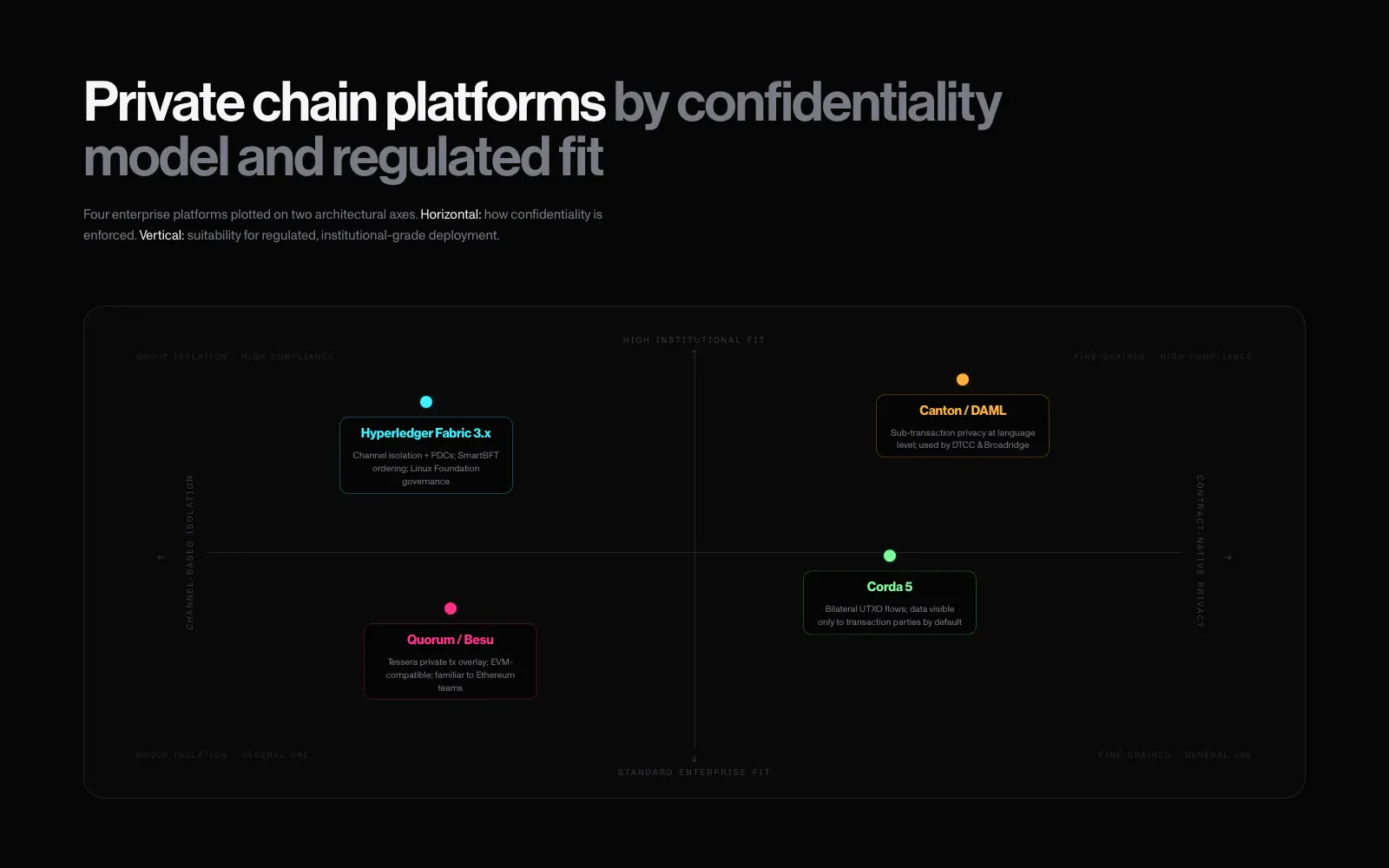
The four leading enterprise blockchain platforms positioned by how confidentiality is enforced and how well each fits high-compliance, regulated deployment contexts
The four platforms that appear in serious enterprise evaluations in 2026 are Canton Network/DAML, Hyperledger Fabric 3.x, Corda 5, and Quorum/Besu. Every competitor comparison article on the current SERP omits Canton entirely, despite it being in production at DTCC and Broadridge scale. The table below includes it.
The table above deliberately excludes throughput numbers where verified figures are unavailable. Anyone citing TPS without workload context is selling you a benchmark, not a deployment reality. What matters is throughput under your specific transaction shape and participant count.
For a deeper look at Canton Network's architecture and Aegas's implementation practice, see the Canton Network development service page.
How does Canton Network's sub-transaction privacy differ from Hyperledger Fabric's channel isolation?
This is the architectural distinction that almost no comparison article in the current SERP addresses, and it determines platform fit for complex multi-party workflows.
Fabric channels are private subnets. When you create a channel, all members of that channel see all data on that channel. Private Data Collections (PDCs) add a partial workaround: you can configure specific data fields to be visible only to a named subset of channel members. But PDCs require explicit per-data-type configuration. As participant sets grow and data access patterns become more granular, you're architecting an increasing number of channel and PDC topologies by hand. Each topology decision is a governance surface that needs documentation and change control.
DAML enforces visibility at the language level. In Canton with DAML 2.0, privacy is not a channel topology: it is a property of the contract itself. Every contract action declares explicitly which parties can see it. The Canton synchronizer, which coordinates consensus across independent participant nodes, sees only encrypted message metadata. It does not see transaction content. Each participant receives the minimum data their role in a workflow requires, enforced at the execution layer, not the infrastructure layer.
The practical difference in a multi-party RWA settlement workflow is significant. Imagine a workflow with four parties: issuer, custodian, transfer agent, and investor. Each needs a different data subset. In Canton/DAML, the visibility model is defined in the contract code and enforced automatically. In Fabric, the builder must architect a channel topology that partitions data correctly for each party combination, then maintain that topology as participants join, leave, or as the workflow evolves.
From Aegas's Canton/DAML proof-of-concept work on multi-party settlement workflows: sub-transaction privacy removes the manual channel-topology planning that an equivalent Fabric design forces you to do up front. That is not a performance difference. It is a reduction in architectural complexity that compounds as the participant set grows.
Aegas perspective. We've built private-ledger PoCs on Canton/DAML and evaluated Hyperledger Fabric against the same multi-party workflows. The channel isolation model in Fabric is well-understood and serviceable for consortium deployments with stable, small participant sets. But for multi-party workflows where each party genuinely needs a different data view (which describes most capital markets settlement and RWA distribution workflows), maintaining correct channel topology as participants change is an ongoing engineering and governance cost. DAML's approach moves that complexity into the language, which is the right place for it. For enterprise blockchain integration work that spans both platforms, see our enterprise blockchain integrations practice.
If you're evaluating which platform fits your current architecture, our blockchain consulting services guide covers the technical tradeoffs in more depth.
How to apply the Aegas Private Chain Selection Matrix to your build decision
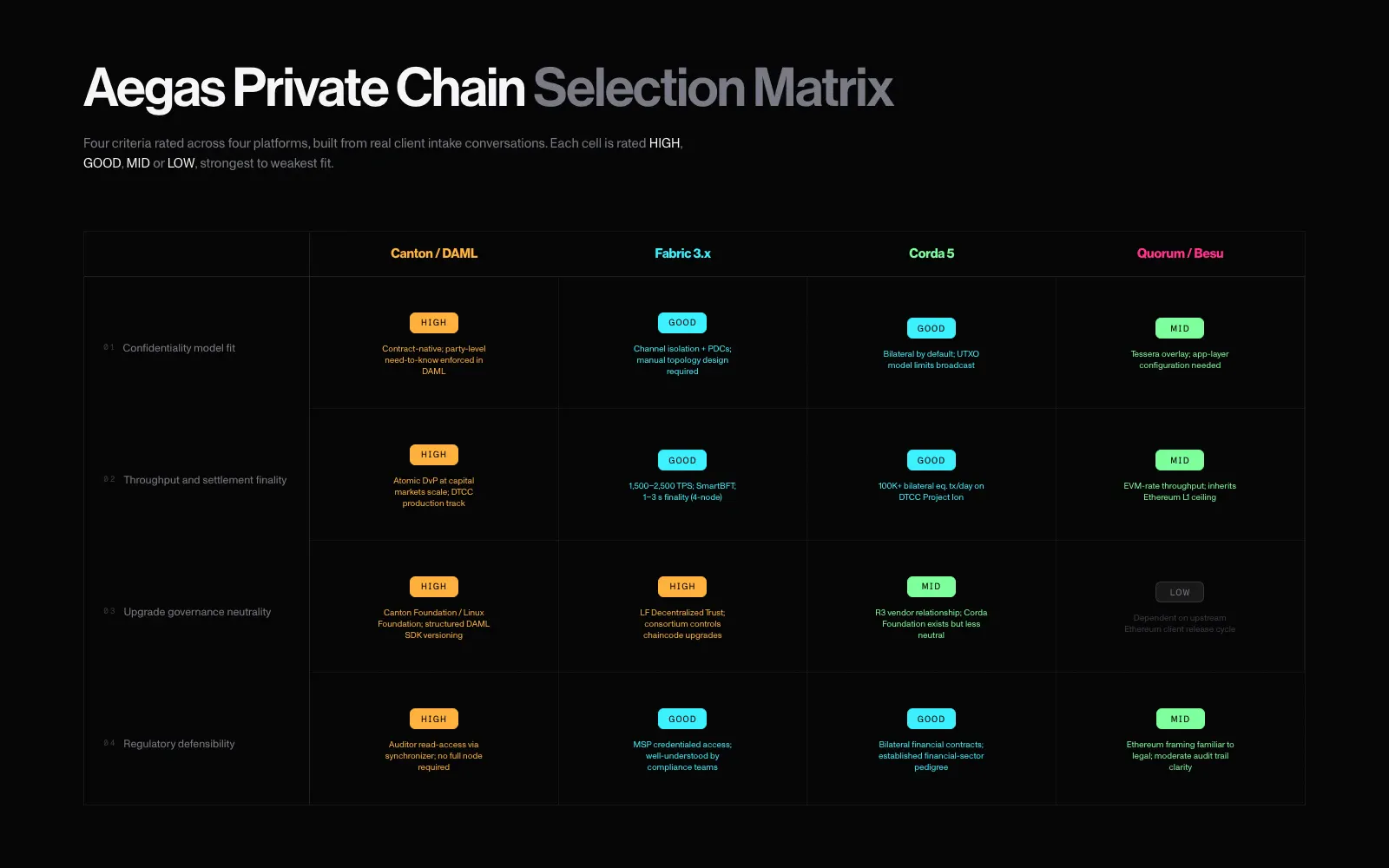
Aegas Private Chain Selection Matrix: four criteria rated across four platforms, color-coded from high fit (gold) to weaker match (grey)
The Aegas Private Chain Selection Matrix is a four-criterion scoping tool built from hands-on Canton/DAML PoC work and the public production record, not from vendor marketing. It is not a replacement for legal counsel on regulatory classification. It is an architectural decision aid for the scoping phase.
Criterion 1: Confidentiality model fit
Does each party in your network need a genuinely different data view, or is channel-level isolation between groups of participants sufficient?
- If each party needs a unique data view enforced at the contract level: Canton/DAML.
- If partitioning by group or data type is sufficient, with manual PDC configuration: Hyperledger Fabric.
- If workflows are primarily bilateral (two parties per transaction): Corda.
- If you need EVM compatibility with private transaction support: Quorum/Besu.
Criterion 2: Throughput and settlement finality
Is real-time atomic Delivery versus Payment (DvP) required at financial market scale, or is T+minutes batch settlement sufficient?
- Atomic DvP at market scale with deterministic finality: Canton.
- T+minutes batch with pluggable consensus and BFT ordering under Fabric 3.x: Hyperledger Fabric.
- High-volume bilateral equity-style transactions: Corda (DTCC Project Ion reference).
- Standard EVM throughput with Tessera privacy overlay: Quorum/Besu.
Criterion 3: Upgrade governance and smart-contract lifecycle
Who controls protocol upgrades? Does the governance structure need to be demonstrably neutral?
- Managed upgrade path, DAML SDK versioning by Digital Asset, Canton Foundation under Linux Foundation: Canton.
- Consortium-controlled chaincode upgrades, full autonomy, Linux Foundation open governance: Fabric.
- R3 vendor relationship required for core protocol changes: Corda.
- Upstream Ethereum client release cycle: Quorum/Besu.
Criterion 4: Regulatory defensibility of the underlying model
Does your regulator or external auditor need to inspect network state without becoming a full participant node?
- Yes, read-only auditor access without full node participation: Canton's synchronizer model supports this.
- Standard enterprise MSP / credentialed node access: Fabric, Corda, Quorum/Besu all satisfy this at the infrastructure level.
Run your use case through these four criteria in sequence. The first criterion where a platform fails to fit is the disqualifier. Most regulated capital-markets use cases with multi-party access requirements land on Canton. Most supply-chain and enterprise consortium use cases with stable participant sets land on Fabric. The matrix output should feed into a proper scoping engagement, not replace one.
For the consulting and architecture phase before committing to a platform, our blockchain consulting services covers how we structure that process.
Can a private blockchain support RWA tokenization? A scenario walkthrough
The DTCC–Canton production track is the clearest real-world parallel, and it illustrates the workflow directly.
Step 1: Asset origination and legal wrapping. A regulated financial institution (in this scenario, a custodian bank holding DTC-eligible US Treasury securities) completes the legal documentation that establishes the on-chain representation as a valid claim on the underlying asset. This step is off-chain. The chain records the token; the legal wrapper makes it enforceable. Your legal counsel classifies the instrument and determines applicable obligations. Aegas builds to whatever classification counsel lands on.
Step 2: Smart contract issuance and whitelisting. The tokenized security is issued on the private ledger. In a Canton/DAML model, the issuance contract defines which parties can hold, transfer, or observe the instrument. ONCHAINID or an equivalent identity layer handles KYC-gated whitelisting. In a Fabric model, equivalent logic sits in chaincode with MSP identity verification gating write access. In both cases, the whitelisting contract is itself a governance surface: who controls the whitelist, and what's the audit trail for additions and removals?
Step 3: Atomic DvP settlement. The buyer and seller nodes initiate a Delivery versus Payment transaction. In Canton via the DAML ComposerX platform (which DTCC and Digital Asset are deploying), delivery of the tokenized security and payment leg settle atomically: either both complete or neither does. This eliminates settlement risk at the protocol level rather than managing it through bilateral collateral arrangements. The DTCC partnership targets this specific workflow for the first half of 2026 go-live.
Step 4: On-chain audit trail for regulatory reporting. Every state transition (issuance, transfer, redemption, failed transaction) is signed and permanently recorded. For regulatory reporting, this is the audit trail. No reconstruction from application logs required. Audit firms can inspect the on-chain record; on Canton, they can do so without becoming full participant nodes.
The governance question this walkthrough surfaces: the whitelisting smart contract is a critical control point. Who controls it in your consortium? What's the procedure for adding a new investor, removing a sanctioned party, or upgrading the contract? These questions need answers before build begins, not after deployment.
For a full breakdown of how private ledger architecture maps to RWA tokenization requirements, see our RWA blockchain development practice page.
What does consortium governance and upgrade-path planning actually require?
Zero of the top-10 SERP pages for "private blockchain development" address this in any depth. It is also where production deployments most frequently encounter problems that a PoC never surfaced.
Four operational governance requirements a CTO must plan before build:
1. Protocol upgrade authority. Who decides when the underlying protocol upgrades, and what is the process? Fabric operates under LF Decentralized Trust (Linux Foundation), with the consortium controlling its own chaincode versioning independently of protocol releases. Canton operates under the Canton Foundation, also under Linux Foundation auspices, with Digital Asset managing the DAML SDK versioning. Corda's core protocol has historically required a closer vendor relationship with R3. The neutrality of governance structure becomes relevant when a critical security patch needs to go out under time pressure: you want a process that is documented and tested before an incident.
2. Chaincode and smart-contract versioning. Smart contracts on a live network must be upgradeable without losing historical state and without requiring all participants to simultaneously update their node software. Fabric uses explicit chaincode version management through its lifecycle process: consortium members must approve a new chaincode definition before it activates. Canton uses DAML's explicit upgrade mechanism, where contracts can be migrated to new templates with defined backward compatibility rules. In both cases, the versioning procedure is a governance document as much as a technical spec. Audit firms want to see it.
3. Participant onboarding and offboarding. How does a new participant join? Key issuance, MSP credential provisioning in Fabric, or DAML party registration in Canton: each has a defined process. More critically: how does a participant exit? Key rotation, data migration for records the exiting party holds, and contractual obligations for data retention all need to be specified before the first participant ever joins. Offboarding an institution from a live consortium without this planning is a multi-month legal and engineering exercise.
4. Dispute escalation paths. On-chain state is authoritative but doesn't resolve disputes about whether the on-chain state reflects what the parties intended. Consortium agreements need a defined escalation path: first to a technical committee, then to legal arbitration if necessary. The chain doesn't make this easier by itself; it just makes the evidence unambiguous.
Aegas's Canton/DAML PoC work gave us hands-on exposure to Digital Asset's upgrade tooling; our read on Fabric migration chaincode here is from evaluation, not a production deployment. The DAML SDK upgrade path is more structured; Fabric gives more autonomy. Fabric's autonomy is genuinely useful for consortia that want full control of their smart-contract roadmap. It also means the migration responsibility sits entirely with the consortium's development team.
How much does private blockchain development cost and how long does it take?
Cost is driven by four variables: number of participating organizations, complexity of the confidentiality model, identity and KYC layer requirements, and scope of legacy system integration. Two engagement shapes cover most enterprise builds:Engagement typeIndicative cost rangeIndicative timelineProof of Concept (2–3 participants, single workflow)$30,000 – $150,0004–10 weeksFull-scale regulated multi-party network$150,000 – $500,000+16–32 weeks
These are indicative planning ranges for this class of build, not a fixed quote. The final number tracks scope: participant count, confidentiality model, identity and KYC depth, and the integration surface. We scope a figure against your specific workflow before any commitment.
Timelines have compressed. A production-ready Fabric network that took 20–40 weeks pre-2023 now runs in 4–8 weeks on the PoC track with Fabric 3.x managed channels and established tooling. Canton's DAML SDK provides structured project scaffolding that further reduces setup overhead. The compression is real, but it applies to the network infrastructure, not to the legal wrapper, governance documentation, and identity architecture that a regulated deployment also requires.
The single biggest cost multiplier is confidentiality model complexity. A consortium with five participants who all need identical data views is far cheaper to build than a consortium with five participants who each need a different data view. Run your use case through the Aegas Private Chain Selection Matrix before scoping an engagement. Platform choice directly determines build complexity and therefore cost.
The Aegas perspective: what building Canton/DAML private-ledger PoCs taught us
Aegas has built private-ledger proofs of concept and demos on Canton/DAML, and evaluated Hyperledger Fabric against the same multi-party workflows. These are different kinds of work, and the architectural lessons don't transfer one-to-one.
On Canton/DAML: the DAML visibility model is genuinely superior for multi-party workflows where need-to-know is granular. What we saw building PoCs is that the complexity budget a Fabric design spends on channel topology planning (deciding which data is visible to which subset of participants, documenting that topology, updating it as the participant set changes) effectively disappears in a DAML-based Canton build. That complexity is absorbed by the language model. The tradeoff is that you're working within DAML's contract model, which has a learning curve for teams coming from Solidity or Java chaincode.
On Fabric 3.x: SmartBFT ordering is a genuine improvement for Byzantine-fault-tolerant consortium scenarios. For deployments where participants are known but not all equally trusted, a common position in trade finance and multi-institution supply chain networks, BFT ordering is the right choice over Raft. Fabric 3.1's batched chaincode writes also target high-key-cardinality workloads that were previously limited by single-key write contention. (Our Fabric assessment here is from evaluation against the public 3.x release notes and benchmarks, not a shipped Fabric deployment.)
Michael Su, CEO of Aegas, frames the platform difference this way:
"On Canton, who sees what is part of the contract. On Fabric, it's network plumbing you design and maintain yourself. For multi-party settlement, that difference is the whole decision, not throughput."
– Michael Su, CEO of Aegas, June 5, 2026
On audit coordination: Aegas ships code and coordinates third-party audits through firms including Hacken and OpenZeppelin. Aegas is the builder; the audit firms provide independent security review. If you need smart contract development plus coordinated audit coverage for a private-ledger build, that is the engagement model we work within. See our smart contract developer services for scope details.
Last updated: May 21, 2026
About the author: Michael Su is the CEO of Aegas, a blockchain development agency he has led since 2017 through 100+ shipped projects spanning DeFi protocols, RWA tokenization platforms, NFT marketplaces, and enterprise blockchain integrations. He works directly with technical founders and procurement leads to match build requirements to the right chain, team structure, and engagement model.