

Last updated: July 29, 2026
TL;DR. If you've ever looked for "RWA tokenization companies to tokenize your asset," you're choosing between two kinds of companies. A regulated issuance platform holds the license your asset needs to trade legally (a transfer agent, broker-dealer, or exchange registration): Securitize, Ondo Finance, ADDX, Bitbond, and tZERO hold one directly, while Tokeny and Polymesh supply the infrastructure underneath rather than the license itself. An engineering vendor (Aegas, Antier, Suffescom, LeewayHertz and a dozen similar firms) builds the system around it: investor portal, KYC, custody, corporate-actions logic. Most teams need both, platform first. The vendor tier below is ranked by work you can open and check.
The freshest inputs here are from late July 2026: Securitize Capital LLC's SEC investment adviser registration on top of its transfer agent and broker-dealer status, and roughly $34 billion in on-chain distributed RWA value. That figure moves week to week; don't quote it as fixed.
Do you need a tokenization platform or a development team?
This guide is for the team that already has the asset, a fund or a property portfolio, and now looks to get it issued and trading on-chain in a compliant manner. Before comparing names, settle one question: who holds the license your asset needs?
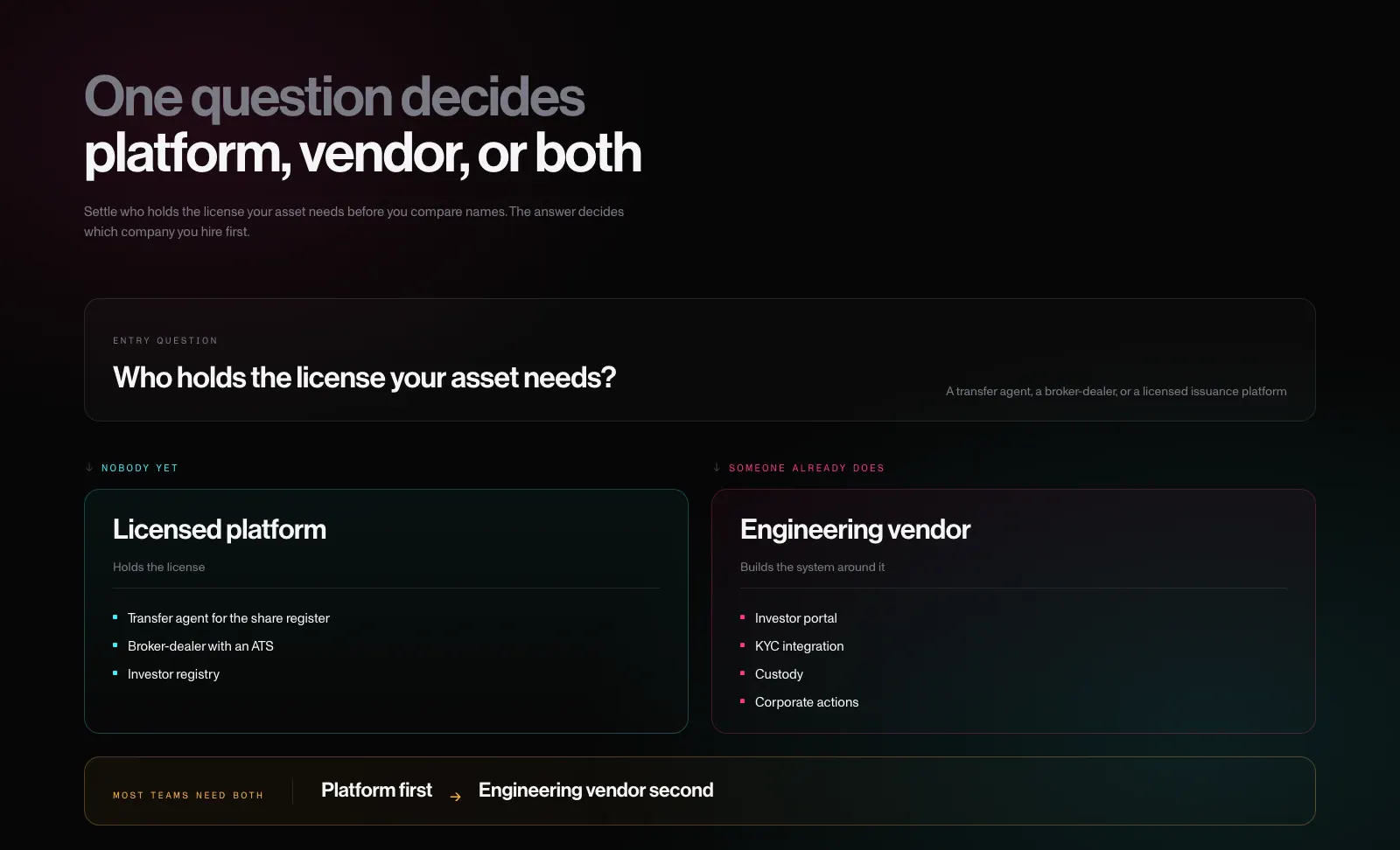
One question decides whether you need a platform, an engineering vendor, or both, platform first
You need a platform when nobody holds it yet: a transfer agent who can maintain the share register, a broker-dealer with an ATS for secondary trading, an investor registry that enforces who can hold the token. Securitize, ADDX, and Bitbond all sell this, and Tokeny supplies the infrastructure under it. You need an engineering vendor once that relationship exists and what's missing is the system around it: the investor portal, the KYC integration, custody, corporate actions. Our RWA tokenization development page walks through that fork before either conversation starts.
What's the difference between a white-label tokenization platform and a custom build?
White-label means you license a platform's stack (Securitize's or Tokeny's infrastructure, ADDX's exchange) and plug your asset into rules someone else wrote. You supply the asset and, usually, the regulatory relationship. It is faster and cheaper because the compliance logic already exists and has cleared a regulator. The cost is control: you inherit the platform's reporting format, its data model, and its reading of whichever standard it runs.
A custom build means an engineering vendor writes the smart contracts and compliance logic to your specifications. It costs more and takes longer, since nothing is pre-cleared, but keeps corporate actions, forced transfers, and jurisdiction-specific rules yours.
Blockchain App Factory, Debut Infotech, and Omisoft all publish near-identical white-label-versus-custom comparisons, and none names the actual fork criterion: whether you already hold, or can acquire, the regulatory relationship a white-label platform requires. Without it, white-label is the only fast path, since custom still needs someone downstream to hold the license. With it, or if the platform's rules don't fit your asset, custom is the only way to keep the logic yours.
Our blockchain development company selection guidance covers the rest. Conflating the vendor question with the platform question is how buyers end up with someone who can write Solidity but has never touched a transfer-agent relationship.
Which regulated issuance platforms hold up in 2026?
| Platform | Regulator / license | Token standard | Model | TVL or AUM (source, date) |
|---|---|---|---|---|
| Securitize | SEC: transfer agent, broker-dealer/ATS, plus (Securitize Capital LLC) investment adviser, registered Jul 22, 2026 | Multi-chain issuance; no single public standard | Acts as transfer agent | $4.39B [Chainstack, 2026-07-08] |
| Tokeny | No regulator held directly; infrastructure used by regulated issuers | ERC-3643 (T-REX), originated by Tokeny | Infra/tooling: on-chain identity registry | $32B+ tokenized under the standard (vendor-claimed, Tokeny/Chainalysis) |
| Polymesh | No single financial regulator named; node operators must be licensed financial entities; SOC 2 Type 1 (2025) | Native Polymesh protocol | Infra/tooling: permissioned L1 | Not disclosed |
| Zoniqx | None named | DyCIST / ERC-7518 | Infra/tooling: asset lifecycle management (TALM) | Not disclosed |
| Centrifuge | None named | Protocol-specific; no single public standard confirmed | Infra/tooling: tokenized private-credit pools | $1.64B [Chainstack, 2026-07-08] |
| Ondo Finance | FINRA clearance (2026) for tokenized stocks/ETFs to US investors | Not a single named standard in materials reviewed | Issuer: tokenized Treasuries, money-market exposure | $3.62B [Chainstack, 2026-07-08] |
| ADDX | Singapore MAS: Capital Markets Services Licensee, Recognised Market Operator, Exempt Financial Adviser (CMS100798, since 2020) | Not disclosed | Regulated market operator / issuer | Not disclosed |
| Bitbond | BaFin (Germany); first BaFin-approved tokenized-bond prospectus (BB1); issuance under eWpG, Luxembourg fund regimes, EU DLT Pilot Regime | Publishes own ERC-1400/ERC-3643 comparison; no single default confirmed | Issuer under BaFin oversight | Not disclosed |
| tZERO / Archax | tZERO: SEC-registered, FINRA-member broker-dealer (US). Archax: FCA-regulated (UK) | Not disclosed | Split model: tZERO distribution/custody, Archax issuance/lifecycle (GOVY, partnership since Jun 23, 2026) | Not disclosed |
The platform table below only includes platforms that clear one of two bars: a named regulator or license, or a formalized token standard with disclosed adoption. TVL and AUM figures carry a source and date, since these numbers move weekly, and several platforms don't publish one at all. The figures for Securitize, Ondo Finance, and Centrifuge come from Chainstack's July 8, 2026 platform comparison.
Securitize is the one entry with a complete regulatory stack. Securitize Capital LLC registered with the SEC as an investment adviser effective July 22, 2026, on top of the existing transfer agent and broker-dealer/ATS registrations. That puts four regulated functions under one roof (transfer agent, broker-dealer/ATS, investment adviser, fund administration), a combination no other platform here holds.
Tokeny sits at the opposite end: infrastructure rather than a regulated entity in the Securitize sense. Its T-REX engine enforces compliance inside the token contract rather than through a company acting as transfer agent. Whether Tokeny itself ever takes on a transfer-agent role is unclear, so this table doesn't claim it either way. What's confirmed is an identity-registry architecture used by DTCC, Apex Group, Invesco, Franklin Templeton, and Fasanara Capital.
One number gets conflated across almost every competing list. rwa.xyz's "distributed" value, tokens issued and freely tradable on-chain, sat around $34.67 billion as of late July 2026, down from a $35.2 billion peak on July 10, 2026. Its separate "represented" figure, assets committed to tokenization but not yet tradable, runs $218 billion to $388 billion. A platform citing a market "worth $300 billion" likely means represented value, which says nothing about whether an investor can exit a position.
If your asset needs institutional settlement rather than retail-style secondary trading, Canton Network is a different lane. Fireblocks added Canton Coin custody support in February 2026. That DAML-based permissioned settlement model is what our Canton Network development page covers.
Which engineering vendors can build the integration layer, and how do you read their claims?
| Company | Founded | Independent rating & reviews | Production work you can open and check |
|---|---|---|---|
| Aegas | 2017 | Clutch 4.9/5 (15 reviews), GoodFirms 5.0/5, TechBehemoths 5.0/5, DesignRush 4.7/5 | Yes. Privex, a perpetuals DEX on Base and Coti: $22B in platform volume to date, 8M executed trades. Nest DEX, a ve(3,3) AMM on HyperEVM: $2.43B cumulative volume, still maintained by the team that built it. DeFi trading systems, not tokenized securities, and the section below says what that doesn't prove |
| Antier Solutions | 2011 | Clutch profile exists, 48 reviews; score not retrieved | No named, openable production system found. Headcount 700-738 (LeadIQ and own marketing disagree); "15+ years" self-reported; ranks itself in its own list |
| Suffescom Solutions | Not confirmed | Clutch: 108-117 reviews across a paginated listing; score not retrieved | None found. Ranks itself #1 on its own published list |
| LeewayHertz | 2007, San Francisco | Clutch 4.7/5 (9 reviews); GoodFirms 5.0/5 (5 reviews) | None found. Headcount disputed: PitchBook 300, Tracxn 182 (May 2026), same company |
| PixelPlex | 2007 (own claim) | Clutch profile exists, 33 reviews; score not retrieved | None found. "80+ projects", "$500M in client revenue raised", "1M+ smart contract executions", all self-reported |
| SoluLab | 2014 (own claim) | Review count not retrieved | None found. "1,500+ projects, 500+ clients" self-reported |
| Debut Infotech | Not confirmed | Not confirmed | None found. Marketing-page claims only |
| Blocktunix | Not confirmed (Crunchbase profile exists) | Clutch "Foremost Blockchain Development Firm in UAE" mention; count not retrieved | None found. Marketing-page claims only |
| Hivelance | Not confirmed | Not confirmed | None found. Marketing-page claims only |
| Blockchain App Factory | Not confirmed | Not confirmed | None found. "12+ years of expertise" self-reported |
The agency tier holds no licenses to check, so the usual proof is a directory profile, and the directories disagree with each other. That leaves one test that works: can you open the software the vendor built, today, and see it running with real money moving through it? A platform's license doesn't get you an investor portal, and most competing lists blur the two tiers: Suffescom's "Top 10" post ranks Securitize, a dev shop, an RPC provider, and itself on the same numbered list, with no category label at all.
We publish this list and we're on it, at the top. So is nearly everyone else who publishes one: Suffescom ranks itself #1 on its own list from January 15, 2026, and Antier places itself second on its own list, behind Securitize. The difference we'd ask you to hold us to is the last column. Every figure in the Aegas row is either a live URL you can open now or a rating on a third-party profile you can check yourself. Apply that standard to our row and to whoever is on your shortlist.
LeewayHertz's headcount is reported as 300 employees by PitchBook and 182 by Tracxn, a 65% spread between two paid directories describing the same company at the same time. Company numbers on directory pages are compiled, not audited. A vendor quoting "300+ engineers" is repeating a figure two directories can't agree on. Most of the rest of this table offers project counts and client counts with nothing behind them.
"None found" means a named, currently-reachable production system was not found in the company's own published materials during this research. Several of these firms have almost certainly shipped work under NDA, which is a real constraint. The point is what a buyer can verify before signing.
Why Aegas sits at the top of its own table, and where that evidence stops. Since 2017 the team has shipped 100+ projects. The two in the table are trading systems: Privex, a perpetuals DEX at $22B platform volume and 8M trades over two years, and Nest DEX, a ve(3,3) AMM at $2.43B cumulative volume on HyperEVM.
They do not prove investor-facing compliance reporting or a KYC-vendor integration, because neither project needed them. If a vendor's cited work is DeFi trading, ask specifically how they'd handle the pieces that only appear in a regulated context: corporate actions, forced transfers, and an identity registry your KYC provider has to feed. Ask us that too. Contracts go to third-party auditors by name (Hacken, OpenZeppelin, Trail of Bits, Halborn, CertiK, Sherlock).
Aegas isn't a transfer agent or any other regulated entity, so the license comes from the platform table, and it isn't an audit firm; it coordinates audits with the firms named above. A vendor who blurs either line is worth a harder look.
How do you choose a vendor? Start with the disqualifiers.
Every name in the vendor table above, and most that didn't make it, will say yes to "have you built RWA tokenization before." That question eliminates no one. The eight below do, each answerable inside a single scoping call.
- Can they name the regulator and license number behind a compliance claim? Naming one separates a regulatory relationship from a feature description.
- Will they produce a reference client who'll take a call? NDA-bound and shuttered projects are real constraints, but zero references across every engagement is a different signal.
- On a platform deal, can they say who is the transfer agent of record, them or the platform? A vendor who can't answer that in one sentence doesn't understand what they're building.
- Is "12+ years of experience" backed by one checkable detail, a chain, a timeline, an outcome?
- Can they explain how corporate actions work on the standard they're proposing: a dividend, a forced transfer, a redemption? Reaching for the whitepaper instead of a plain answer is the tell.
- Will they quote one flat price before scoping custody integration and which KYC vendor they'll connect? A number that early means the scope isn't defined yet.
- Are they conflating "we support ERC-3643" with "we're a registered transfer agent"? A compliant smart contract is not authorization to maintain an official investor register.
- If contracts are already live, which third-party firm audited them: Hacken, OpenZeppelin, Trail of Bits, Halborn, CertiK, Sherlock, or one you haven't heard of? Calling an internal review "the audit" is a different thing.
None of the competing lists (Finextra, Suffescom, Antier, Blockchain App Factory) publishes anything like this, because each is a vendor or a vendor-adjacent host with a stake in its own ranking.
Which token standard should you use: ERC-3643, ERC-1400, or CMTAT?
ERC-3643, known as T-REX, is the standard behind Tokeny's infrastructure: compliance rules live in the token contract itself, so a non-compliant transfer fails at the contract level. Tokeny's own figures put adoption at over $32 billion tokenized across 180-plus jurisdictions, a vendor-claimed figure, not an independent audit. ISO certification for the standard was reported in progress as of May 2026, not finalized; several sources frame it as a prerequisite for sovereign-wealth-fund and pension-manager adoption.
ERC-1400 is older and relies on off-chain checks rather than an on-chain identity registry. Bitbond's own published comparison frames it as stronger on operational flexibility, with ERC-3643 stronger on auditability at the cost of gas and complexity. One secondary source calls ERC-1400 "the more practical choice for the majority of RWA projects in 2026," against the ERC-3643-dominance narrative coming from Tokeny-adjacent sources. Make whichever vendor you're evaluating justify the choice in specifics (gas cost, jurisdiction, the exact compliance behavior needed) rather than accepting "3643 is the standard now" as settled fact.
CMTAT is Swiss, from the Capital Markets and Technology Association, and chain-agnostic by design rather than written as an ERC. Its reference implementation is Solidity, built on OpenZeppelin for EVM chains including Ethereum, with a separate Solana implementation, so "not an ERC" doesn't mean "not available on Ethereum." Its stated advantage is native support for debt-based tokens and forced trades, which ERC-3643 and ERC-1400 handle less cleanly. If the asset is a bond or structured product, CMTAT is worth putting on the table.
Watch one more figure. The $1.2 trillion tokenized-securities market number attributed to analyst firm Digital Asset Research and cited on Bitbond's standards page likely counts committed or represented value under a broader securities definition, well above the roughly $34 billion actually trading on-chain. Competing pages put both numbers in the same paragraph, which would have you planning a build for a market roughly 35 times larger than the real one. Standard choice drives build cost and timeline, which our token engineering and launch service treats as a first decision to lock.
How much does the integration layer cost?
The cost guides on this topic, Octal Software, Antier, and Pixel Web Solutions, all price one thing: building a tokenization platform from scratch, usually $100,000 to $3 million depending on scope. None prices what most buyers actually need: the integration layer around a platform they've already licensed.
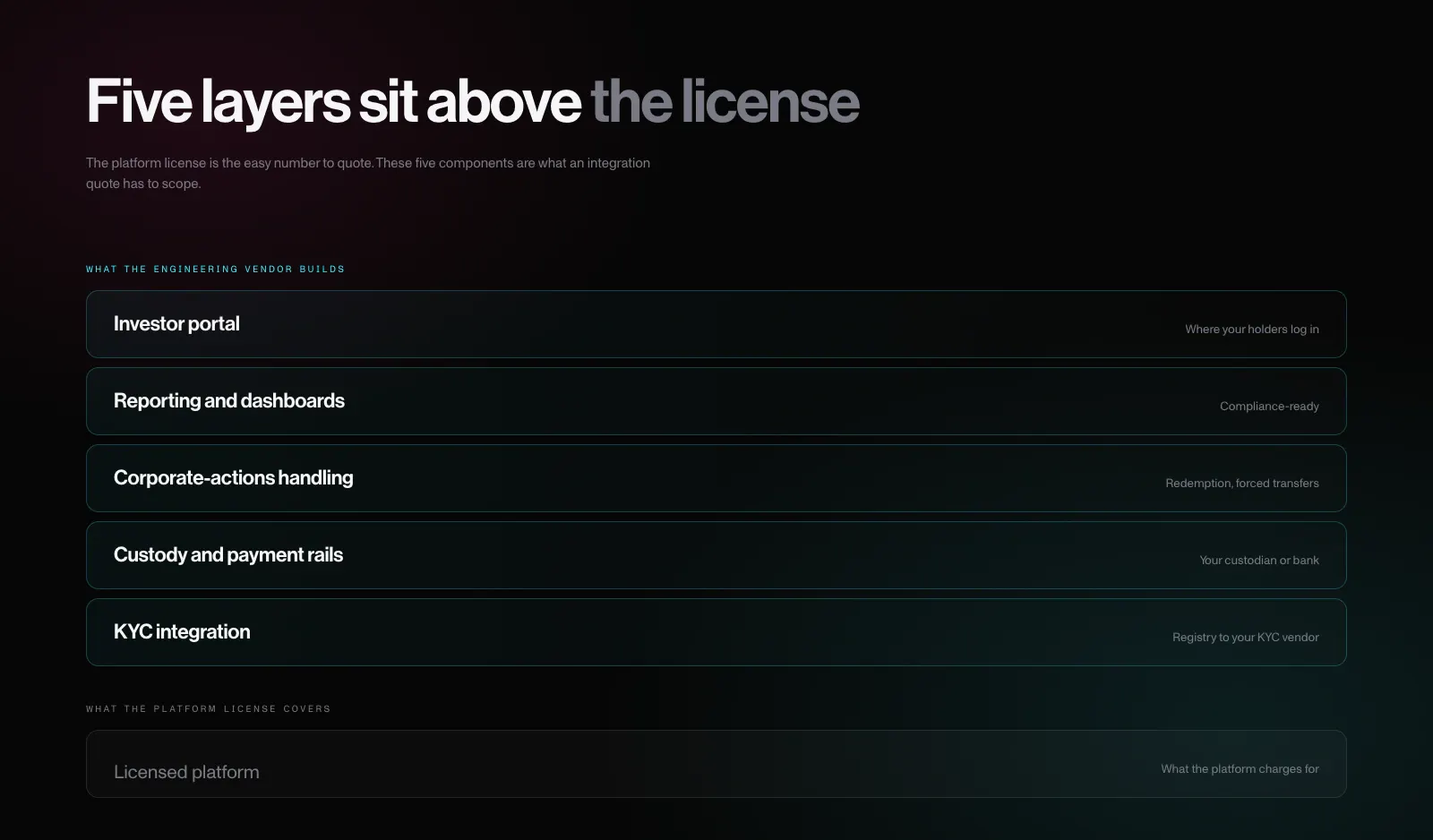
The platform license prices easily; these five components are what an integration quote has to scope
That layer is separate from whatever Securitize, Tokeny, or ADDX charges for the platform itself: an investor portal your holders log into, compliance-ready reporting and dashboards, corporate-actions handling for redemption and forced transfers, custody and payment-rail integration wired to your custodian or bank, and a KYC integration linking the platform's identity registry to whoever runs your investor due diligence.
None of that has one honest number, because it scales with how many rails and vendors you're connecting. A quote call should establish three things: how many custody or payment rails need integrating; how many KYC vendors are in play, your existing provider or the platform's own or both; and whether the corporate-actions logic is templated against the platform's structure or fully custom because your asset's redemption rules don't fit.
A vendor who answers those three specifically is quoting a scope. One who skips straight to a number is quoting a guess. Our blockchain integration services coverage goes deeper on the integration work, which is where most of the budget goes.
This is the work Aegas is set up to quote, scoped from your rails and your KYC provider rather than a template. Our RWA tokenization development page is the tokenization-specific version of that conversation.
Aegas perspective. What breaks, in engineering terms, when a licensed platform meets a live investor base is rarely the smart contract itself. More often it's the seam between the platform's identity registry and whichever KYC vendor the client already ran, or a corporate-actions rule the template doesn't cover because it was built for the platform's median customer, not this specific asset. None of it shows up on a platform's marketing page, because solving it was never the platform's job; that work falls to the buyer, or whoever gets hired to build the layer around the license.
Michael Su, co-founder, Aegas
So, platform, agency, or both?
If the missing piece is the license or the transfer-agent relationship, start with whichever entry in the platform table holds the relationship your asset needs. If that's settled and what's missing is the system around it, pick an engineering vendor against the disqualifiers above rather than off a self-ranked top-10 post.
When you get to the engineering half, run the disqualifiers on us. Ask which auditor signed the contracts and who the transfer agent of record is on your deal, then ask for the reference call. Open Privex and Nest DEX and see whether the answers match what's running. Tell us what you're tokenizing and we'll scope the layer around it.
About the author. Michael Su is co-founder of Aegas, a blockchain engineering agency that builds smart contracts, DeFi protocols, and tokenization systems. He works directly with technical and compliance leads to sort out which parts of an RWA build belong to a licensed platform and which belong to the engineering team wiring it together.